Well Kim Dotcom is still trying, but missed his first deadline:
http://kim.com/mega/
How far away is the new site? Dunno. We'll see.
http://kim.com/mega/
How far away is the new site? Dunno. We'll see.

 Topic: MEGA Almost Online - Misses Deadline (Read 13,120 times)


What is this?


Not sure I like that domain name. mega.co.nz --> Mega Conz --> Mega Cons?Priceless

 - carpe noctem
What is this?


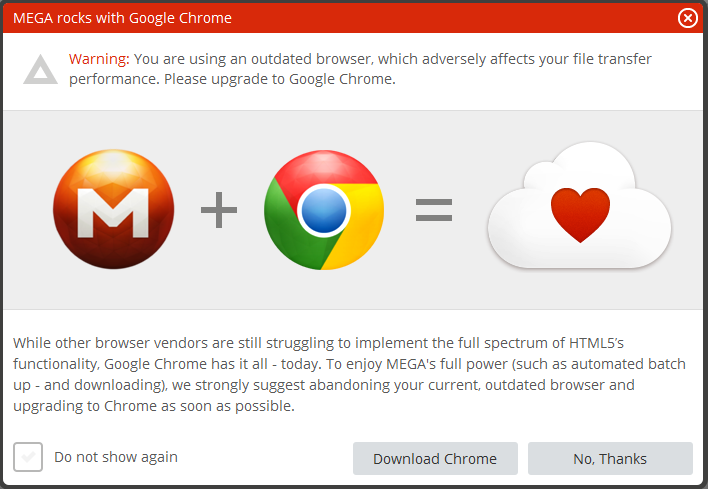
Mega can go fuck itself....
When a developer force shows you this, which is an obvious lie...I have no time for it.
 I cant remember...)


(or are they really saying any other browser is crap!?)


just out of curiousity: was your browser uptodate?It shows even for the latest firefox - doesn't pop up right away, you have to upload some files for it to show.
- carpe noctemMega can go fuck itself....
When a developer force shows you this, which is an obvious lie...I have no time for it.
just out of curiousity: was your browser uptodate?
(or are they really saying any other browser is crap!?)
Google seem to be spending a lot of money promoting Chrome.
I've come across a couple of apps lately that wanted to install chrome (could Java RT have been one of them
In case you’ve been living under a rock the past few days, Kim Dotcom (of Megaupload infamy) has launched his new cloud storage site, Mega. Mega has an impressive sales pitch, promising secure cloud storage where only the user has the key to decrypt his or her files, and the encryption and decryption happens securely in the browser.
Today we aren’t going to take a look at their encryption or their key generation, which have already been the subject of several articles. Instead, we’re going to look at the security of the Mega website itself. As Mega themselves admit, if you use their web interface (and not a third-party client), the security of the entire ordeal depends on whether you trust them. After all, anyone with the ability to modify the site could just replace the JavaScript code with one that sends them (or anyone else) your password or master key. There’s no way around having to trust Mega for this, but you also have to trust that Mega’s site is delivered securely to you.
The standard solution to this problem is to use a strong form of SSL. However, Mega chose an interesting approach to SSL. Instead of serving the entire site from a single secure server or group of servers using strong SSL, they came up with a clever scheme to allow them to serve most of their site insecurely. Mega’s main index.html is hosted on a secure server using SSL with 2048-bit RSA. However, everything else is loaded dynamically from JavaScript code in index.html, and hash checked. This additional content comes from a CDN that uses weaker 1024-bit SSL with MD5 authentication. The CDN servers are third-party servers, and thus potentially easy to compromise for an attacker. Therefore, you would have to trust the entire CDN network and also trust that nobody has broken 1024-bit SSL yet (which is known to be weak by modern standards). In order to solve this problem, Mega hashes all of the additional content, and stores the hashes in index.html. This creates a chain of trust, or as they put it, “secure boot for websites”. Clever.
There’s nothing inherently wrong with this idea. However, security designs are only as secure as their implementation. Let’s look at Mega’s “web secure boot” implementation.


Dotcom’s Mega Pushes More Bandwidth Than New Zealand
Ernesto June 5, 2013
Kim Dotcom’s Mega has grown exponentially since its launch earlier this year. According to Dotcom, the bandwidth generated by the encryption-focused file-hosting platform has now exceeded that of the entire country of New Zealand. At the same time, the number of complaints by copyright holders remains remarkably low at 80 to 100 DMCA requests per day.
mega - The introduction of Mega has been one of the most successful tech launches this year.
In a matter of days the site’s membership went from zero to more than a million and in the weeks that followed the site continued to expand its user base.
Thus far Kim Dotcom and his colleagues have kept most of their statistics under wraps. However, earlier today Mega’s founder said that “the privacy company” now pushes more bandwidth than the entire country of New Zealand.
“Only 5 months after the #Mega launch we are now pushing more bandwidth than the entire country of New Zealand,” Dotcom tweets.
Mega’s founder doesn’t specify any numbers but Mega’s bandwidth should be well over 100 million petabytes at this point.
While the site’s traffic still pales in comparison to the defunct Megaupload and several other file-hosting services, it’s still a force to be reckoned with. The company certainly doesn’t lack any ambition and hopes to go public on the New Zealand or Australian stock markets in the near future.
Those not sharing in the Mega excitement thus far are Hollywood and the major music labels. The RIAA has devoted part of its website to tell the(ir) “real story” about Megaupload and would prefer it if Dotcom disappeared from the limelight.
Interestingly, however, copyright holders haven’t had much to complain about during Mega’s first few months of business. Although Hollywood studios have tried to get Mega de-listed from Google on copyright grounds, not many complaints have been sent to the cloud hosting company itself.
Dotcom informed TorrentFreak that the number of DMCA notices per day doesn’t exceed double digits, yet more than a million files are uploaded per day.
“We currently receive between 80 – 100 notices per day. That’s tiny considering the 1.6 million uploads we receive daily and compared to the takedown volume of sites like Dropbox & YouTube,” Dotcom informs TorrentFreak.
“We are reacting swiftly to these takedown notices, just like we did at Megaupload,” Dotcom adds.
Indeed, Mega’s numbers are nothing compared to the tens of thousands of notices other service providers receive. In part this difference can be explained by the fact that unlike Dropbox and YouTube, Mega doesn’t allow Google to index its files.
One thing is clear though, U.S. authorities and copyright holders will have a hard time portraying Mega as a criminal operation setup to infringe on content owners’ copyrights.
It will be interesting to see whether Mega can keep up current growth in the future and “take over” a few other countries in the process.
Dotcom Resigns as Mega Director to Focus on Music Venture
Ernesto - September 4, 2013
Kim Dotcom has stepped down as director of Mega, the cloud hosting service he successfully launched earlier this year. According to a statement the Internet entrepreneur has decided to free up time for other projects, including ongoing legal battles and his political aspirations. In a few months Dotcom will also launch a new music service, the name of which is being kept secret for the time being.
dotcom-laptop - On January 20, a year after Megaupload was raided in 2012, Kim Dotcom launched his new file-storage service Mega.
In a matter of days the site’s membership went from zero to more than a million and in the weeks that followed the site continued to expand its user base.
The introduction of Mega has been one of the most prominent tech launches this year and the privacy company has big plans to expand its business in the future. But despite the early successes, Kim Dotcom has chosen to move on.
Filings to the New Zealand Companies Office reveal that Dotcom was replaced as Mega Director last week. The move was confirmed to BusinessDesk by Mega CEO Vikram Kumar, who said that Mega’s founder will use the time to work on his many other projects.
One of the new ventures Dotcom will focus on is the music platform formerly known as Megabox. Unlike Mega, the new music service will be operated by a company owned by the Internet entrepreneur himself.
Dotcom previously told TorrentFreak that he dropped the Megabox name for a better one, to be revealed at a later date. Dotcom did say that unlike his other projects, he will not be using the “Mega” brand for the new music service.
There are currently 22 developers working on the project and it’s expected to launch a few months from now.
In addition to the music service, Dotcom also has political aspirations. A few days ago he told TorrentFreak that he has written a draft program for a new party that he wants to participate in New Zealand’s elections next year.
“I’m excited about the party and I’m confident that I can help make New Zealand a significant Internet economy player. Someone needs to lead New Zealand into the future. Unfortunately the current government doesn’t know what the future looks like,” Dotcom said.
Aside from the music venture and his political aspirations, Dotcom will also be focusing on Megaupload’s legal battles. He and several of his Megaupload colleagues are fighting an extradition request from the United States, where they are wanted for several alleged crimes.
Dotcom’s extradition hearing is currently scheduled for November this year, but may be pushed to April 2014 because legal arguments on a number of issues have complicated the case. In the United States, Megaupload has asked the court to dismiss the criminal indictment against the company, but a decision on this request is yet to arrive.
Related Posts
Dotcom’s Mega Pushes More Bandwidth Than New Zealand
New Zealand Gave Kim Dotcom Residency, Knowing He Was Wanted By FBI
Dotcom Given Green Light to Sue Kiwi Spies, But Evidence to be Withheld
Mega Eyes Stock Market as Secret Dotcom Extradition Hearing Gets Underway
U.S. Government Wins Appeal in Kim Dotcom Extradition Battle
Original address: https://www.donationcoder.com/forum/index.php?topic=33746.0