topbanner_forum
  *

avatar image

Welcome, Guest. Please login or register.
Did you miss your activation email?

Login with username, password and session length
  • Friday December 19, 2025, 9:08 pm
  • Proudly celebrating 15+ years online.
  • Donate now to become a lifetime supporting member of the site and get a non-expiring license key for all of our programs.
  • donate

Recent Posts

Pages: prev1 ... 354 355 356 357 358 [359] 360 361 362 363 364 ... 470next
8951
General Software Discussion / Re: A cool Screen saver
« Last post by 40hz on June 30, 2010, 06:40 PM »
Very nicely done indeed!  :greenclp: The transitions between the objects are particularly interesting to watch.

Grab Version 2 however.

He parked his copyright slug on the lower left of the screen with version 2. The earlier one had it moving along with the animated image.

Watching RAD01©2010 rotating around the screen in sync with the pretty graphics took something away from it. Glad he thought so too! :Thmbsup:

 :)


8952
Does this feel like yet another choreographed 'leak' to anyone else besides me?  :-\
8953
^Well there's one sure way to find out. All they'd have to do is temporarily block all the US controlled IP address blocks on their main routers and DNS servers to see what happens.

But I'm guessing it would have some major economic 'ramifications' for the rest of the world too.

Might be an interesting experiment.  8)

Might also be an absolute disaster.  ;D
8954
Living Room / Re: What books are you reading?
« Last post by 40hz on June 30, 2010, 03:03 PM »
Oooo...Lovecaft!

One the most original of the modern sci-fi/horror sub-genre writers. He basically created the category.

Grab yourself a heaping dish of elder god sushi and settle in for some fun reading.
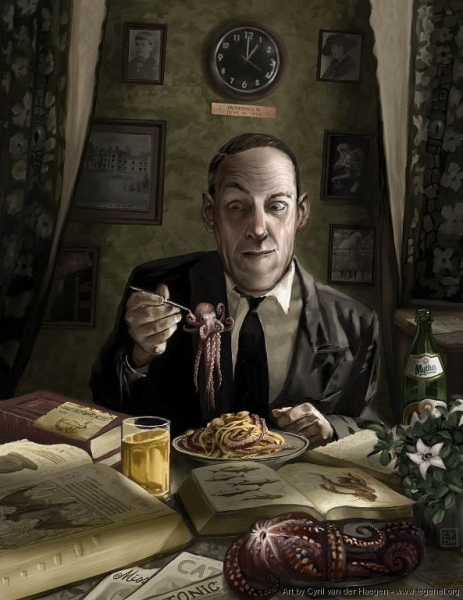
Birth_of_Cthulhu-015a.jpg

If the descriptions seem vague, the quotations from the Necronomicon maddeningly short, the 'known' facts incomplete and sometimes even contradictory, don't be surprised. Lovecraft deliberately wrote it that way. He firmly believed the reader's imagination could create a more frightening mood when working with hints than their rational mind could working with vivid descriptions. Besides, what description could accurately convey his idea of trans-dimensional, god-like, yet utterly evil entities, whose presence phases in and out of our own time-space continuum.

That's the beauty of Lovecraft. The danger isn't confined to specific places or a times. The minions of Cthullu and the Elder Gods are separated from us by only the thinnest of dimensional walls. Do something wrong, or be a little too confident or careless, and the bogyman really will get you in Lovecraft's universe.

Lovecraft was an avid amateur astronomer. And he also lived at the very start of the era that produced the first real breakthroughs in nuclear energy, particle physics, and relativity. Fascinated as he was by all of this (and being a 'confirmed rationalist' by his own admission) he still admitted to an occasional vague anxiety about where this scientific research might lead mankind. Some of this anxiety, and his concerns about the possible societal reaction to Einstein's new vision of the universe, finds voice in some of his stories:

The sciences, each straining in its own direction, have hitherto harmed us little; but some day the piecing together of dissociated knowledge will open up such terrifying vistas of reality, and of our frightful position therein, that we shall either go mad from the revelation or flee from the deadly light into the peace and safety of a new dark age.  -The Call of Cthullu

Interestingly, most of the people who run afoul of these entities in Lovecraft's stories did so by being a little too curious for their own good. They read a forbidden book they shouldn't have, conducted scientific research into something better left alone, played around with an artifact they knew was evil.

For example:

Possibly Gilman ought not to have studied so hard. Non-Euclidean calculus and quantum physics are enough to stretch any brain; and when one mixes them with folklore, and tries to trace a strange background of multi-dimensional reality behind the ghoulish hints of the Gothic tales and the wild whispers of the chimney-corner, one can hardly expect to be wholly free from mental tension.

But he was still content, for at one mighty venture he was to learn all. Damnation, he reflected, is but a word bandied about by those whose blindness leads them to condemn all who can see, even with a single eye.  -Dreams in the Witch House

and...

If the thing did happen, then man must be prepared to accept notions of the cosmos, and of his own place in the seething vortex of time, whose merest mention is paralysing. He must, too, be placed on guard against a specific, lurking peril which, though it will never engulf the whole race, may impose monstrous and unguessable horrors upon certain venturesome members of it.  -Through the Gates of the Silver Key

So what is this "specific lurking peril?"

In one of the few 'quotes' Lovecraft provides from the Necronomicon he 'explains' a bit about what these entities are:

Nor is it to be thought that man is either the oldest or the last of earth’s masters, or that the common bulk of life and substances walks alone.

The Old Ones were, the Old Ones are, and the Old Ones shall be. Not in the spaces we know, but between them They walk, serene and primal, undimensioned and to us unseen.

Yog-Sothoth knows the gate. Yog-Sothoth is the gate. Yog-Sothoth is the key and guardian of the gate.

Past, present, future, all are one in Yog-Sothoth. He knows where the Old Ones broke through of old, and where They shall break through again. He knows where They have trod earth’s fields, and where They still tread them, and why no one can behold Them as They tread.

By Their smell can men sometimes know them near, but of Their semblance can no man know, saving only in the features of those They have begotten on mankind; and of those are there many sorts, differing in likeness from man’s truest eidolon to that shape without sight or substance which is Them.

They walk unseen and foul in lonely places where the Words have been spoken and the Rites howled through at their Seasons. The wind gibbers with Their voices, and the earth mutters with Their consciousness. They bend the forest and crush the city, yet may not forest or city behold the hand that smites.

Kadath in the cold waste hath known Them, and what man knows Kadath?

The ice desert of the South and the sunken isles of Ocean hold stones where Their seal is engraven, but who hath seen the deep frozen city or the sealed tower long garlanded with seaweed and barnacles?

Great Cthulhu is Their cousin, yet can he spy Them only dimly. Iä! Shub-Niggurath!

As a foulness shall ye know Them. Their hand is at your throats, yet ye see Them not; and Their habitation is even one with your guarded threshold.


Yog-Sothoth is the key to the gate, whereby the spheres meet.

Man rules now where They ruled once; They shall soon rule where man rules now.
After summer is winter, and after winter summer...

They wait patient and potent, for here shall They reign again.

So are these things gods? Alien intelligences? The ravings of some lunatics who make these things real only by their belief in in them and their willingness to act on what they believe are commands to serve them?

Who knows. And who cares?  ;D

Lovecraft deliberately puts his readers in the same position as the characters in his stories - confused and struggling to make sense out of something that is basically beyond the ability of the human mind to envision or understand. When Lovecraft talks about the 'unknown' he means the 'unknowable.'

Clark Ashton Smith, who was one of Lovecraft's proteges, wrote many stories using characters and concepts from the Cthullu Mythos. Some years after Lovecraft's death he even tried to arrange the entities into a pantheon of sorts by assigning the various Elder Gods to an elemental framework: Cthullu = water, Hastur = fire, Shub-Niggurath = earth, and Ithaqua = air; and set them in an almost bibical "war in the heavens" backstory.

It didn't work.

I personally prefer Lovecraft's concept of something malignant and unknowable that forever hovers just on the fringe of our senses and subconscious awareness. Something as vague and immaterial as a half remembered nightmare. Something that may abruptly manifest itself and wreck havoc before vanishing just as quickly and without a trace.

Cool stuff.

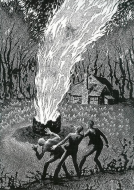
Lovecraft's favorite story was The Colour Out of Space. He felt that one best succeeded in capturing the sense of awe and fear someone might experience when confronting the completely 'unknowable' as opposed to the merely unknown.

My favorite too!

Here's Virgil Finlay's artwork for the story. (Finlay was Lovecraft's favorite illustrator.)
colour.jpg

 8)


-----

P.S. Your objection to the plot problem in The Call of Cthullu has bugged a lot of Lovecraft fans. I always wondered about that part myself even though there was an explanation (of sorts) in the story as to what had happened. A bit unsatisfying, but what can  you do? <*sigh*>

 :Thmbsup:


8955
Living Room / Re: Linux Learning - what to do after basic install?
« Last post by 40hz on June 30, 2010, 12:19 PM »
While we're on the subject of good books, get a copy of this ASAP:

Linux Administration Handbook (2nd Edition) (also known as "Big Pink.")  :-*

linux-administration-handbook.jpg

Score your own copy of this. Your friends will soon be envious - and your enemies terrified!

1040 pages of rock-solid hardcore information and sundry goodness. Virtually anything you will ever need to know about Linux systems administration can be found within this hefty paperback. Very readable too!

If you only buy or plan on reading one book, make it this one.

Tux sez: pink.gif


8956
^ But only as long as the backbone is allowed to remain up.

AFAIK, the killswitch is primarily designed to force a shutdown of all the backbone routers.

Take the backbone down and it's back to modems and running Fidonet.  :-*  :P

Hmmm...it's always smart to have a contingency plan.

Maybe resurrecting Fidonet isn't too crazy an idea when you think about it. ;)

------------

note: the old Bell Telephone System had network emergency shutdown/lockout capabilities in place since shortly after the start of the Cold War. It was put there so the President could prevent an enemy from using the phone system in the event of a land invasion. This capability has been a part of the US phone system ever since.

-----------/

@app103
Same situation where I live.

My GF works for the state. People are constantly threatening to sue her agency. Sometimes they even do.

When her agency, or an employee of the agency, gets either a summons, or a subpoena to appear in court, the document is immediately forwarded to the State AG's office.  An attorney from the AG's office will then show up in court the very next day and enter a motion to quash.

In 99.9999% of the cases, the request is granted.
8957
How much compensation will internet based companies be entitled to? And what about multinationals trading in the US?

If it was actually used - even for 5 minutes - the law suits would grind the US government to a halt for years!
-Carol Haynes (June 29, 2010, 12:19 PM)

Not necessarily. I'm guessing they'd get zip assuming they even made it into court.

I don't know enough about international law to know how the USA could be sued somewhere other than in the United States. But in this country, it's very difficult to sue the Feds. That's because our government has sovereign immunity under US law.

So unlike John Bull, Uncle Sam can't be sued in federal court unless he agrees to let you sue him.

From Wikipedia: (empahsis added.)

In the United States, the federal government has sovereign immunity and may not be sued unless it has waived its immunity or consented to suit. See Gray v. Bell, 712 F.2d 490, 507 (D.C. Cir. 1983). The United States has waived sovereign immunity to a limited extent, mainly through the Federal Tort Claims Act, which waives the immunity if a tortious act of a federal employee causes damage, and the Tucker Act, which waives the immunity over claims arising out of contracts to which the federal government is a party. The Federal Tort Claims Act and the Tucker Act are not as broad waivers of sovereign immunity as they might appear, as there are a number of statutory exceptions and judicially fashioned limiting doctrines applicable to both. Title 28 U.S.C. § 1331 confers federal question jurisdiction  on district courts, but this statute has been held not to be a blanket waiver of sovereign immunity on the part of the federal government.

As the Wikipedia points out, there are some cases where immunity is considered waived by other legislation. But even then, there are enough limits and statutory exceptions that it doesn't amount to much.

From my personal experience with the Feds, there seems to be a simple rule in effect. You are allowed to sue only if an individual employee in federal department or agency did something that resulted in monetary damages; or, if some government agency breached a commercial contract they signed with you by refusing to pay.

Otherwise, you can forget it.

When it comes to issues beyond basic tort and contract claims, the only time I've ever seen the government allow itself to be sued is when it is 100% sure it will win in court. The reason it does that is because sovereign immunity doesn't play out too well politically. It's heavy handed. And it comes as a shock to most people when they discover such a thing exists.

So Uncle Sam prefers to secure favorable court rulings in order to establish legal precedent whenever possible. Not that he really needs to. It's just that it looks better that way.


8958
When you can deploy over a quarter of a million US service people overseas and keep them there for going on a decade, and spend three trillion dollars in the process - then we are at war.
...
Same goes for not calling something what it is.

The thing is, your logic gives government unlimited power. On the one hand, they've transgressed, upsetting the lives of millions of Americans (not to mention the foreigners), and spent hundreds of billions of dollars of our money.

Now, you're saying that because they've done that, we should knuckle under and accept other curtailments of our freedom as well? That just doesn't make sense.

That's not what I'm saying at all. I'm saying that trying to put a pretty face on a situation by calling it something it's not plays into the hands of those who are abusing their political power.

The first step to overcoming an addiction is to acknowledge you have an addiction. And the first step to finding a solution to a problem is to accept that you have the problem. But you're never going to solve the problem or right the wrong until you stop trying to get around an unpleasent reality by calling it anything other than what it is.  

Right now it's not so much a question of preventing the governent from doing a power grab. They've already done one. Now the question is how do you get the control restored to the citizens. Because as things stand with all the new 'emergency' powers the government has been procedurally (since I'd hestate to characterize it as legally) granted, the United States meets the definition of a police state.

So I'm not granting the government anything. All I'm doing is calling a duck a duck.

And like it or not, our government does have de facto unlimited power. How much of it gets used is only regulated by it's willingness to let itself be regulated by law. If it is unwilling to accept legal limitations, it ignores the law. This can be made easier if the citizens give government their tacit approval to do so. National emergencies and patriotic fervor are good for that. But that's not absolutely necessary for laws to be ignored.  Take a look at any good political history of the US for examples. Sidestepping the law is nothing new for our government. In some respects, the overall 'theme' of American political history is the story of how all real power gradually came to be centered in the federal Executive Branch.    8)
8959
The only thing I see that's different is the President now has the legal authority to hit the kill switch.

The ability and power to do so were already there.

Not that it matters. The US government has become very comfortable with legal and constitutional ambiguities. And the Executive Office has always been granted considerable flexibility and discretion when it bumps up against laws limiting its powers. And in situations where this flex doesn't exist, the Executive Branch often creates it's own. 

I view this as something akin to the warning label on cigarettes. You knew those things could kill you before they issued the warning. The only difference is that now the risk has been officially acknowledged.
    
8960
Living Room / Re: Weekend moment of zen -- Caturday!
« Last post by 40hz on June 29, 2010, 09:39 AM »
What kind of Caturdays do you think I have when one of my cats thinks she's a dog. If one is not ever-vigilant one may find themselves pinned down on the couch being licked vigorously.

Wow. We used to have a cat-dog too. Shadow thought he was a dog. He hung out with the dogs, ate out of the same dish with one of the dogs, chased and played with the dogs, howled with the dogs, and loved to play fetch with humans. Loved the dogs' liver treats, only drank water, and absolutely hated catnip and milk.  

Weirdest, coolest, and most fun cat we ever owned. Even the dogs were upset for days after we lost him to complications following surgery when he was only a few months over three.

Genuine 'once in a lifetime' cat, that one.  

  
8961
General Software Discussion / Re: Truecrypt defeats FBI
« Last post by 40hz on June 29, 2010, 01:17 AM »
40hz: I´ll do it. Tell me your wishes for such a program.
mwb1100: I made a file-encryptor with implemented OTP that has a hardware radioactivity as a source for pure randomness: Crush Cryptonizer

Not trying to make work for you, but if you're looking for a NANY project here goes...

Tell me if this makes any sense:

The biggest problem with most people is their passwords. They're too short, too simple, and lack sufficient randomness.

What if there were an encryption package that took a relatively easy to remember password and used that as a seed to produce a very complex, very long password that got used to do the actual encryption?

That way, you could know your file was encrypted using AES or Blowfish or whatever; and you could know that the password you used to do the encryption was something like  i<399ntyRNs. ("I love 99 naughty nurses!") - but what you wouldn't know is the real password used for the encryption because the app used your i<399ntyRNs to generate something like this to do the actual encryption:

9frB&SNSYWlbN?TRZ+X6M&s)Sxt;2}wSL6OhAUG,`B&P|[.-O^*m%R`%JM7An`:
ge?NP2:t'%KM_Ih'!<$n+'5FnvVPGg\amea~I3,(-M~gC0;&fw:ejL3(,GJt`t<
4~B'>#4[IRb4G=)#b5o<NR)gQp=_/0QqZV~mOawt|%.HEEA=-@PLoS[CI;1?}C"
cUU+xoO0!>/wqq`VhY/H81?)`TgXLq''YCq{Zl?1BX|fAyo6X:(Kq;$-_q':<7%

It might also be cool to use the user password in conjunction with something like the filename for the seed so that each generated password would be different for each file, even though the same user password got repeatedly used.

So now, the 'real' password for FILE01.TXT would be totally different than that for FILE02.TXT - despite user password: i<399ntyRNs being the same on both.

This offers three advantages:

1. The file is encrypted using a highly long and complex password that has a good degree of randomness. And even though it's not genuinely random, it's still more random than most people could come up with. (Our minds are so full of subconscious associations that it's next to impossible for us to be random.) Now those 256 or 512+ character passwords become viable even though the user doesn't know what they are or ever have to remember them.

2. In order to decrypt the file, you'd also need to use the same app that generated the complex password. So having the file and knowing what the encryption algorithm and user password was wouldn't help you decode it unless you knew the internally used password - or knew how to generate it.

3. Each generated password is different for each differently named file even if the same user selected password gets used repeatedly because the file name is also part of the seed. So now there's less of an issue reusing an easily remembered user password so long as each filename is different.

Note: rather than screw around with a hex editor and binaries, you could get a similar result by manually renaming the file after encryption. Since the name is part of the seed, doing something as simple as adding a digit to the end of the file name (i.e. FILE123 becomes FILE1230) would break decryption even if you had the app and the user selected password.

Sorry... it's late, I'm exhausted - and I'm probably rambling and repeating myself by now...


8962
Living Room / Re: 20 years later, the movie "Total Recall" still kicks butt
« Last post by 40hz on June 28, 2010, 10:48 PM »
@4wd -

re: 40hz's "out"

I think some if you might be misunderstanding my intentions when I speak about Hollywood taboos.

I'm not trying to prove a point about what makes a good or bad movie. Nor am I making a statement about the superiority or inferiority of the mainstream American movie industry.

When I mentioned these "no go" story elements, it was in the context of trying to account for the general lack of originality and the reluctance on the part of the industry to take chances when it came to movie plots. And the reason for this reluctance is twofold: the desire not to offend mainstream public sentiments (i.e. money) and fear of censure by a small but highly vocal 'moral' and conservative collective (i.e. money).

In a nutshell, if it's something that will impact the box office, or draw the public wrath of legislators or the religious, it's not going to be considered for production until those concerns can be minimized. Hollywood is mainly looking to make "4-quadrant" type 'perennial hit' movies. They're rarely looking to make great ones.

Again it's no knock from me. It's just how they perceive their business environment. And American moviemaking is a business.

I didn't come up with these taboos on my own. Many screenwriting books and seminars either hint at or come right out and talk about the issue of "unacceptable" topics. It comes as a shock to many hopeful writers that American movie studios are not all that liberal or open to radical or disturbing ideas for movies - even though virtually all of them would deny it if asked.  

This is one of the reasons why some truly great books get bad screen adaptations. Many of the wild and dangerously thought provoking elements that made the book so great won't be allowed in the screenplay.

Simple reality of the trade: Wanna sell your script to a US studio? Avoid certain topics and images.   8)


8963
Living Room / Re: 20 years later, the movie "Total Recall" still kicks butt
« Last post by 40hz on June 28, 2010, 10:17 PM »
@Shades -

re: No Country for Old Men

Can't say or tell you anything about it. As I said, I haven't seen it yet.  ;)
8964
General Software Discussion / Re: Truecrypt defeats FBI
« Last post by 40hz on June 28, 2010, 05:19 PM »
@mwb1100 - All good points, although since there are many publicly available resources for obtaining true random numbers, that part isn't really a problem.

Note: I'm not advocating one-time pad cryptography. It's basically unworkable for anything other than short messages, as you pointed out. I was just mentioning it as the one cryptographic system that is mathematically known to be 100% unbreakable if implemented properly. At least as far as our current mathematics can determine.

40hz: An additional encryption-locker would be an interesting idea for some kind of NANY...

Would be. If I could code worth a penny, I might be tempted to try writing something like that. Unfortunately, many things have taught me that application coding is not where my talents lie.  ;D
8965
Your post implies that this is a time of war.

Seems to me that it's a "time of war", even though it might not be a declared war.  For my money, hundreds of thousands of dead and maimed people are proof enough.


+1 w/mrainey

When you can deploy over a quarter of a million US service people overseas and keep them there for going on a decade, and spend three trillion dollars in the process - then we are at war.

And all the legalese, think tank mumbo-jumbo, and Washington double-talk isn't gonna change that.

If you call a tail a leg, how many legs has a dog? Five? No, calling a tail a leg don't make it a leg.   - Abraham Lincoln


Same goes for not calling something what it is.

--------------------

Note: Funny how this whole thing was called a war until we learned we weren't going to "win it" as quickly and decisively as we thought. And as time drags on, it's becoming increasingly questionable whether we can "win it" (whatever 'it' is) at all.

But since the US never loses a war, it's now become quite obvious to some that this 'military engagement' can't be considered a war. Because if it were a war, we'd have already won it! QED

 :-\


8966
Living Room / Re: Diagnosis: Email Apnea?
« Last post by 40hz on June 28, 2010, 04:09 PM »
I read the article and thought: hmm...maybe....

Then I mentioned it to my GF and she said: Wow! That's true. I hold my breath all the time when I'm opening something on a computer.

So I guess there really is something to it.  ;)

@app103 - My GF is involved in a major system modernization project for our state's government. She said to thank you for the find. She's going see if the concerns and problems the article talks about can somehow be addressed as part of the workplace changes her group is working on. She's thinking of incorporating proper breathing into the employee ergonomic training program - possibly combined with some sort of popup screen reminders.

Anyway, she thanks you.  :Thmbsup:
8967
Living Room / Re: 20 years later, the movie "Total Recall" still kicks butt
« Last post by 40hz on June 28, 2010, 03:39 PM »
Addendum:

Regarding Chinatown...

The original screenplay had a different ending. Roman Polanski changed it during the production of the film.

Spoiler
Per Wikipedia:

Evans, the producer, intended the screenplay to have a happy ending with Cross dying and Evelyn Mulwray surviving. Evans and Polanski argued over it, with Polanski insisting on a tragic end. The two parted ways due to the dispute and Polanski wrote the final scene just a few days before it was shot.

See also this link.

In the script by Robert Towne (who also wrote the screenplays for The Last Detail and Shampoo) the monster Noah Cross was killed by his daughter, Evelyn. Evelyn had been raped and made pregnant by her father. In Towne's version, Evelyn killed her father to protect her daughter from the old man's predations.

This is the kind of ending you can imagine Raymond Chandler writing. Evelyn might die along with her father, the only way to put an end to his evil, but there would be some hope, with Evelyn's daughter having a chance at salvation.

Polanski changed Robert Towne's ending to let Noah Cross destroy Evelyn and take possession of his grand-daughter as his new slave. Why did Cross do this? Because he could. Because he was rich and politically powerful and normal human beings didn't matter next to his whims.


So I guess it's once again correct to say that Hollywood didn't OK Polanski's ending when it put the script into production. It was only when nearing completion that the ending got changed to what eventually became the released version.

Ok...I'm gonna go back to my earlier assertion that Hollywood doesn't greenlight films where human evil absolutely triumphs over good.

That's my story - and I'm sticking to it!  :Thmbsup:

(At least until I find the time to watch No Country for Old Men, There Will be Blood, Skeleton Key and re-watch Wicker Man to see if it happened in any of those. Thx Innuendo!  :Thmbsup: ;D)

8968
Sometimes that's the way it goes:

     Their bat...

          Their ball...

              Their yard...

You wanna play with these boys, you play by their rules.  :-\
8969
General Software Discussion / Re: Truecrypt defeats FBI
« Last post by 40hz on June 28, 2010, 02:29 PM »
Hmm...

One old technique is to intentionally corrupt the encrypted file in a reversible manner. All you need to do is open the encrypted file in a hex editor, change one or more bytes using some arbitrary schema, and save it.

Example: After encrypting, add 1 to the first byte in the first three rows.

Original file
01.gif


After encryption
02.gif

After editing hex values
03.gif

Until these changes are reversed, the file cannot be decrypted even if the password and encryption method are known. Since encryption algorithms depend on every byte in the encrypted file being correct, any change anywhere in the file makes decryption impossible. And because the changes made are completely arbitrary, they don't readily yield to cryptographic analysis and cracking techniques.

Note that many encryption software products also add headers and CRC checksums to their output files, so it's important to test the "corrupted" file to make sure the encryption utility can't repair it. The goal is to have decryption produce gibberish or no output rather than report a file error - which is a dead giveaway that the encrypted file had been tampered with.

Encrypting the same file twice, using two different algorithms and passwords (or even using the same algorithm and password) can also make cracking the file virtually impossible.

And any encryption system that utilizes a properly implemented One-Time Pad technique is still completely unbreakable using analytic methods.

At least according to all the information that is publicly available.  8)  ;D

8970
Living Room / Re: 20 years later, the movie "Total Recall" still kicks butt
« Last post by 40hz on June 28, 2010, 12:36 PM »
^ I feel your pain. Once you get out of college, those great ad hoc debate and discussion groups seem to disappear from our lives. If we're not careful we end up discussing nothing but our jobs, financial investments, and children. And ten years later we wonder why the new 20-somethings all think we're boring? 

Fortunately, I've been blessed with a few bright friends that still love a good intellectual discussion and are interested in just about anything. Art, movies, string theory, the latest DNA research...bring it up and they're all over it, sharing as much as they know - and eagerly soaking up what they don't. It's great.

Needless to say, I don't have a lot of area friends like that. But at least I have some.  Online gatherings like DC help fill that gap for most of us. But it still can't beat a good F2F conversation IMHO.


Either way, it's usually a smart move to seek out "the community" whenever you can. There's a lot of truth to the notion "We're better together." as the Polyphonic Spree song said.
  
 
:Thmbsup:
 
8971
Living Room / Re: 20 years later, the movie "Total Recall" still kicks butt
« Last post by 40hz on June 28, 2010, 11:35 AM »
I miss the days when going to the movies was really special and fun.  I know I sound one like one of those old geezer back in the day types, but I do miss that.  In college, there were always sneak previews of movies, and for broke college kids, that was really fun.  The anticipation, not knowing what the movie was about AT ALL, all the people...it was good stuff.

Fortunately, with the advent of big screen TV monitors and home theater systems you can recreate a bit of the theater if your lucky enough to be able to afford it.

Get a Netflix subscription and you're in good shape.

But the one thing you need to do to really make it enjoyable is gather a group of fellow movie buffs and all watch it together. Without a small group in attendence, it won't feel the same. Six is a good number. Big enough to feel like a crowd. Small enough to allow for a single discussion about the movie afterwards.  

Learn how to make real movie popcorn, and have everybody take turns supplying the 'beverages of choice' so one person doesn't go broke hosting if you're doing it regularly. (Good venue for homebrewers to show off their latest creations too!) Watch and enjoy. Just don't be surprised if you see the sun coming up before you're done discussing. Especially if it turned out to be an exceptionally good film like The Usual Suspects. (Breakfast anyone?)

You can even do your own film festivals, hall of fame, etc. Take turns recommending and selecting. Maybe even have the person recommending do a little presentation afterwards about the making of the film, the director, or what have you. Just keep it fun. Movies are supposed to be a form of entertainment.  

And if you don't have a fancy media setup, don't let that stop you. Just invite fewer people and sit closer to your old "tube."  
8972
Living Room / Re: 20 years later, the movie "Total Recall" still kicks butt
« Last post by 40hz on June 28, 2010, 11:06 AM »
@Innuendo

I didn't say bad guys winning was the criteria. I said human evil left triumphant.

There's a subtle but very real difference between someone being bad and someone who is evil.

There's an interesting idea writer Arthur Machen once proposed that true spiritual evil is very rare. Even more rare than genuine saintliness. Because whereas the saint was trying to regain what had been lost in The Fall, the truly evil were attempting to seize something never meant for mankind to have. They were attempting to "take heaven by storm" and in doing so, they repeated the sin which led to the war in heaven and the fall of mankind. This took them beyond the human inheritance of "original sin" (with hope for redemption) and placed them with the "fallen" angels who were damned without hope of salvation. In short, evil is something beyond what mankind should be capable of. Evil is the sin of angels. Human evil was not a part of the plan for creation.

Even if you don't buy into the Christian symbology he uses, you can still get the gist of what he's saying.

Evil is a really really really big deal. Badness is more a major annoyance.

Interesting distinction.    

8973
Living Room / Re: 20 years later, the movie "Total Recall" still kicks butt
« Last post by 40hz on June 27, 2010, 09:25 PM »
Re: No Country for Old Men.

Can't speak to that since I haven't seen it.

But after careful thought, I do know of one movie where evil does absolutely triumph: Chinatown. I bounced it off a few film buff friends, and they said that AFATK, Chinatown was unique in that respect. The ending was (and remains) controversial. There were major battles between Roman Polanski and Paramount Pictures to change the ending from what Polanski wanted to a more "happy ending" where good triumphed.

The fact that didn't happen contributed greatly to Chinatown's unique position in American film history.

The concluding: Forget it Jake! It's Chinatown. has got to be one of the most chilling lines ever uttered in a movie.  

--------------
UPDATE: see my post further down. This was not the ending that was in the script when they started shooting...


8974
Living Room / Re: 20 years later, the movie "Total Recall" still kicks butt
« Last post by 40hz on June 27, 2010, 08:58 PM »
One minor point: the human qualification in 'human evil' isn't a loophole. Morality only applies to human beings. You can't apply human morality to non-human entities. The evil wolf is only 'evil' in our eyes because he does us harm. But in a more universal scheme of things, he's only a hunter securing food and protecting his territory. So the wolf is no more immoral for hunting human prey than we are evil for raising cattle and eating hamburger.

Of course to a cow, we are evil in the same sense the big bad wolf is evil to us.

Evil is a big topic. For the purposes of what I'm talking about, Hollywood is only concerned about the evil we do to each other. The cosmic forms of evil are cut more slack because our moral standards do not apply to them.

---------

Re: Usual Suspects.

( One of my all time favs BTW! Great film.  :Thmbsup: )

Close, but no cigar.  :)  

Spoiler
Kaiser Soze sets up the entire scene to kill the one guy who can identify him. He succeeds in getting the Guatamalan informer. Unfortunately, a police sketch artist was able to work up an image based on the description given by a surviving Hungarian gang member who is over in the burn ward. An FBI agent interviews him over the hospitals objections which results in the sketch of Soze. That's how we conclusively know Kaiser Soze is Verbal Kint at the end of the film.

When Verbal says that the greatest lie the Devil ever told was convincing the world he didn't exist, he states what his goal is: to be unidentifiable to the point of where the police doubt he's real.

By the end of the movie, the police absolutely know he does exist - and they finally have his likeness. So despite the fact he escapes at the end, his biggest advantage is now gone. The implication is it will only be a matter of time before he's apprehended now that his cover is blown. And even if he still remains at large, he's lost the biggest advantage he once had - so he failed in his goal.

This is a classic "to be continued" even if a sequel never gets made.

   
8975
Living Room / Re: 20 years later, the movie "Total Recall" still kicks butt
« Last post by 40hz on June 27, 2010, 12:34 PM »
How does that gel with the ending of The Mist ?

While you don't actually get to see the deed done, the killing of the boy is very graphically implied.


As I said, you can imply all you want. But you can't show it happening.

The scene in The Happening where the smart-mouthed kid got shot had to be reworked several times before Shyamalan got an OK from the studio's legal department. Note when you see the film that you don't actually see the boy getting hit even though you do get to see his dead body (partially and briefly) afterwards. And even that is so quick it's almost implied.

That's one semi-spoiler in any movie. If there's a lead character kid in the film that's 12 or younger, you just know they're going to make it through the movie no matter what.You can kill off the heroine, her boyfriend, her dog, and her helpless and elderly Mom and Dad. You can  even nuke the town where she was born. But that 7-year old kid she picks up along the way is always going to be one of the survivors when the credits finally roll.


I would have put it down as trying to milk more money out of the movie watchers.  If they just didn't want to end with evil being triumphant then they could have stopped at Friday the 13th or A nightmare on Elm Street 3: Dream Warriors, (to use your two psycho examples), but they didn't.  From that point on it was just greed, IMO.  (If you follow the premise of New Nightmare you could actually say that Evil has won - who else would be causing all these crappy sequels to be inflicted upon us?)

Anyone who enjoys the SciFi/Horror genre will go along and see the sequel no matter how bad it is, they'll watch the following sequels in the hope they will be better than the previous, etc, etc, etc.

Yes. They could have stopped the follow-ons at any time. But only if it left the 'conflict' in an unresolved state where evil hadn't yet been conclusively defeated. They don't greenlight movies where the script calls for human evil to finally, absolutely, and conclusively win.

And if you do know of an exception, please educate me. Because AFAIK - it just doesn't happen.

Note: I wasn't saying that the taboo against human evil triumphant is what drives the creation of sequels. But it does provide the opportunity to make sequels since it keeps most of these films from reaching their logical conclusion.

I mean c'mon... unstoppable killer repeatedly comes back from the dead after he's been hit with everything from a baseball bat to a tactical nuke? By this time you'd figure he's just a force of nature like a tornado - something to avoid as best you can since there's nothing you can really do about it.

One way out would be if the military rounded up Jason and his ilk and transported them over to the Afghan/Pakistan border to hunt for and kill Bin Laden. After Bin Laden was gone, the Pentagon could send in the cruise missiles and possibly even call in a B2 wing to do a follow up cluster bombing run "just to be sure." International threat removed, evil punished, supernatural evil semi-redeemed but still punished, and America saved!

Give it a name like Leatherface Leathernecks or The Texas Chainsaw Detail with Stallone as the commanding general and Dolpf Lundgren as the 'CIA guy.' Hey, dredge up the Cenobites from  Barker's Hellraiser franchise while you're at it too. Let Bin Laden plan to unleash them in LA as part of his next terrorist attack...

You can probably see why they don't they let me write these things... ;D


How does that gel with the ending of The Mist ?

Note: the following response contains film spoiler. Don't read if you haven't seen The Mist.

Spoiler
The shootings at the end of the film weren't murders. They were mercy killings intended to save his child and the others from a fate worse than death. But even though David ends up shooting them (with their consent) for a noble purpose, he still gets punished. Since killing another is generally considered 'wrong' (especially killing his own child in order to 'spare him') David is punished by his survival - either to face criminal charges; or at the very least, to live with what he has done and the knowledge he was wrong.

The monsters don't qualify for the taboo because they are not human evil.


I'm with you, 4wd. I just don't buy it. Otherwise The Forgotten never would have been made. At the end, IIRC, good does not win. The "Big Bad" persists and its crystal clear that good will never win.

Yet another spoiler laden response on my part... ;)

Spoiler
Good does win. The redhead got her child back.

The aliens aren't 'taboo evil' because they aren't human evil. And even so, the evil alien conducting the experiment gets 'punished' by his own people for his experimental failure. He bet his mind control games could sever that strange spiritual link his people observed between a human mother and child.

Well guess what? It couldn't. Human love (and family ties) triumph over heartless advanced alien experimenters and their human government collaborators.

Plus, they're not gone - so there's an implied "to be continued." Sequel anyone?

If evil did triumph over good, Telly and would have lost Sam, never got her memory back, and that would have been that. In real life that's probably what would have happened. And that would have made an incredibly boring movie. Or no movie at all since it's an inevitable conclusion which offers no opportunity for genuine conflict. And without conflict, there is no story to film...


There are lots of movies and TV shows where evil wins. I'm thankful for that, watching the good guys win in the end. Every. Single. Time. Well, it gets old.

It only gets old when screenwriters can't come up with an original angle on it. But that's why we create fiction rather than just read history. If you want depressing examples of where human evil triumphs, look no further than that - although you might argue that since history is constantly being written and rewritten, it's a never-ending series of stories about the good guys going on to fight another day.

I'm not aware of any movie where human evil triumphs absolutely. There may be films where the bad guys win the conflict, but the protagonists still always wins in terms of spiritual growth, or goes on to fight evil another day- even if its' only by inspiring a new generation with his/her own death.

How 'bout some more titles?

Ain't film appreciation fun? That's why you always want to watch and discuss movies with friends.  ;D  :Thmbsup:


Pages: prev1 ... 354 355 356 357 358 [359] 360 361 362 363 364 ... 470next