This brings back memories. My first computer was a Kaypro II, CPM based transportable. Like my first car, I wish I had kept it.
-edbro
My CP/M machine was a Commodore 128C. The 128C had 3 OS's, CP/M and the C-64 and C128 OS's. About the only command I remember when booting up the 128 was "Go 64", which would boot up in C-64 mode. Great little machine, I had a lot of fun on it.
-Tinman57
Ooooo....
I bought one of those too. What a crazy machine. It had both the Zilog Z-80 and a Motorola 6502 CPU chips in it. Two separate CPUs from
two completely different manufacturers! Talk about a kludge - although it was an extremely clever one. And it worked very well too, although IIRC sometimes switching from C64 mode
back to native C128 mode was a little dicey and required a power cycle. CP/M, in true CP/M style, worked beautifully on it. Like CP/M did on everything it was ever ported to.
The only real "problem" (challenge?) with the C128 machine was programming it. And by programming I mean in assembler. The C128 had the weirdest memory architecture I had ever seen. The whole V20/C64 family's architecture was pretty weird to begin with since the memory map got shifted around whenever a cartridge was plugged into them. The Vic-20 was the most confusing. They fixed that mess somewhat with the C64. But not by much.
The C128, however, was a complete nightmare to get your head around. I must have spent hundreds of hours pouring over the
Commodore 128 Reference Guide for Programmers and
Mapping the 128 along with the other 4 or 5 books Compute Magazine published for the C128. This box was being viewed as a "very serious" machine back then because it had 128
kilobytes of RAM - which was huge for the time. Easily twice that of any of it's competitors. And the programmers were drooling! IIRC even Sams Books had a few programming titles out for it.
Too bad it was so complex not much got written to take advantage of the native mode. And since the 128 could run virtually all the old C64 programs (compatibility was close to 100%) - and the C64 was still selling well - most developers took the safe route and just continued to crank out C64 software. And the business programmers just continued to release their stuff for CP/M, so the native 128 mode never really took off.
Commodore also didn't market the C128 anywhere near as hard as they had the C64. Which greatly puzzled most industry watchers.
But it wouldn't be until later that we found out why they didn't when Commodore unveiled the very much ahead of its time Amiga
1000. Two years after that they would release the incredibly popular Amiga
500 model - and the rest was history. Amiga sold more successfully in Europe than it did in the USA. But it still had a very loyal and respectable following here. In Europe it actually became
the most popular personal computer for a few years. They're still used today. And an Amiga
2000, kitted out with a NewTek
Video Toaster card, brought broadcast quality video editing within the reach of a small studio or serious hobbyist. For about $4000 you could do what it used to take a $100,000 video editor to accomplish. Truly amazing product! The Amiga/Toaster combo did to the world of video what the Macintosh would one day do to the world of publishing.
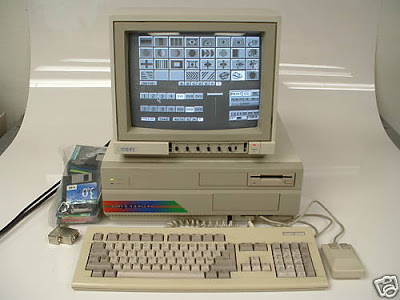
Ah...memories! It all seemed so
magical back then...


 Recent Posts


