My next micro-review is for
Heroscape:
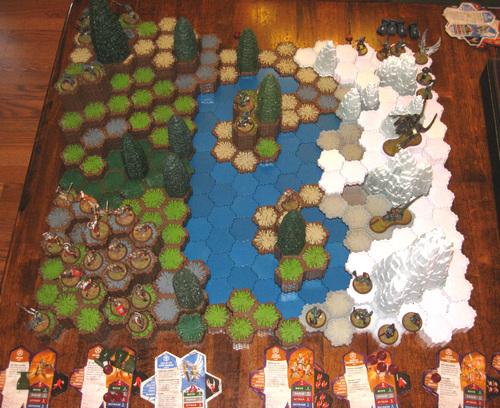
Heroscape is one of the more lightweight "miniatures"-based games, where players control figures that move around on a map and battle.
Tom Vassel (from The Dice Tower) has a 5-part video review of Heroscape
here; it's one of his favorite games.
For me -- the complexity level of Heroscape is perfect -- it's very simple, clear, and straightforward, plays extremely quickly, and is a pure joy.
Heroscape was one of the games that re-kindled my enjoyment of playing games. It also opened my eyes wide to the importance of having something physical to look at and manipulate, in terms of how enjoyable a game is. In many ways heroscape is the closest example of a board game-as-toy. If you have kids that like to build things, this might be the perfect game for your family, since it's sort of like combining lego with toy soldiers, using an elegant set of rules for battle. I've not played any other game that is as purely enjoyable to actually move figures around and get in the spirit of attacking, etc.
Key features:- The best physical pieces of any (affordable) game, pre-painted miniatures and 3d board pieces that make you feel like you are in their world. Kids who like to build things may love just putting together random maps.
- Outstanding theme and creatures; perhaps it's due in part to the 3d nature of the map and the colored miniatures, but i haven't played any game that compared to heroscape in terms of emersion in the experience.
- People who are used to heavy roleplaying games may be dissatisfied with the simple and unchanging nature of the combat and creature abilities; there are no extra weapons to buy and items to equip. But for me it hits the absolute sweet spot in terms of combat and movement. Each character has different abilities and speeds, and squads of multiple figures have very enjoyable interactions. A huge variety of figures and expansions make it always a different experience depending on what creatures you control. You learn the rules very quickly (there is even a simplified-game ruleset for young and newer players).
- There's a lot of luck but also a lot of risk assessment and probability, and a good amount of jockeying for high-ground position. The issue of height-advantage plays a large role in the game and is helped by the 3d nature of the board. Both the attacking player and defending player role dice against each other during a fight, and the player interaction is great. For me it's the perfect complexity level.
- Tons of expansion figures you can buy (these are not cheap, but the base game is very cheap compared to similar games)
- The game book describes varieties of different maps to create and winning conditions; by changing the game goals you can create different kinds of styles of games (though this isnt an adventure/quest game, it's essentially attack and defense, and strategic positioning all the way).
- Great variety of character abilities and asymmetrical play -- it's a great pleasure watching how weak but numerous squads go up against powerful but slow single creatures. Very fun to learn how to make the best use of the unique powers of different figures. And you *really* get into taking on the personalities of your figures, whether you are playing a giant dragon, robots, a squad of samurai, or a flying amazon woman.
- Unlike many games, if you mis-interpret or skip rules, it won't disrupt gameplay much; makes playing with new players, young kids, or during your first playthrough fun
Weaknesses:- After lots of plays, people may get a bit bored; it is essentially a combat game where there are no hidden cards that get revealed to surprise you -- everything is out on the table in the open. A cure for boredom can be had by buying addon figures but they are expensive and take up lots of space.
- The 3d board pieces are a big part of the fun of the game.. BUT.. they are also the biggest weakness of the game, in a way i didn't initially anticipate. Actually setting up a board can take a very long time (20-30 minutes just to set up board?) -- it can be confusing to match the layout described in the book (and i suggest you don't worry about matching it exactly), and can be frustrating. It takes up a ton of space on the table. This aspect of the game makes it hard for me to overcome the resistance i feel sometimes in setting up this game to play. John+Traci who i play games with also love heroscape (which is saying a lot since our tastes differ), and the only thing that stops us from playing it a lot more is the time and effort needed to set it up to play and put it away afterwards. The pieces are kind of big and if you start buying expansions you could need to rent a storage room to hold it all. But if you have a garage where you could leave a giant map set up permanently, it could become a lifestyle for you and your friends.
Game Design Interests:- Great example of the power of physicality/look/feel when it comes to visceral enjoyment.
- Great example of using really minimalistic simple rules and getting real strategic play out of the emergent interactions of probabilities.
- Great example of combining simple but compelling squad-based actions with more traditional actions.
- Great example of variety in figure special abilities, while keeping things simple.
- Interesting use of height as a positional advantage, due to the 3d nature of the board and the rules governing height effects.
- One of the very best examples of how fast and fun a game can be when the primary focus of the game design is on creating a fun experience (as opposed to a deep strategic battle of wits), and how important speed and simplicity is to achieving this.
- Clever mechanism for army "drafting" that works very well to facilitate asymmetric armies that are balanced
Final Rating:9 out of 9; the only thing keeping it from a perfect 10 is the tiresome process of assembling the boards. one of the few games that was an absolute joy to play the very first time we took it out of the box to learn it.
Fellow player ratings: John (9), Traci (10)


 Recent Posts
