topbanner_forum
  *

avatar image

Welcome, Guest. Please login or register.
Did you miss your activation email?

Login with username, password and session length
  • Tuesday April 7, 2026, 8:12 pm
  • Proudly celebrating 15+ years online.
  • Donate now to become a lifetime supporting member of the site and get a non-expiring license key for all of our programs.
  • donate

Recent Posts

Pages: prev1 ... 555 556 557 558 559 [560] 561 562 563 564 565 ... 1515next
13976
I have always laid out cards on a portrait page 3x3 as I then get 9 per page rather than 8. Just a thought!

youll see that the library is very generic about laying out the cards.. its easy to adjust.

that's really the point of this library -- it is code to make it easy to custom code your own quick custom card generation routines, without spending time on the low-level details.
13977
I think it would be useful to get it into a draft state with sample text and share it, and then maybe others can make some variations.
13978
I too thought of the "complete this offer for a free iPad!" type of thing, so that's not a good association. We would just need to carefully avoid that kind of impression.

Yes i am *VERY* keen to avoid any of this gimmicky crap.. Which is why i continue to emphasize that we are just brainstorming here.

One key thing we have to consider is that we don't want people to donate for the wrong reasons -- we want donors to be proud to support the site and feel good about it and try to bring some of them into the community as active participants.  We don't want to go down a road where people are donating the smallest amounts possible out of resentment..  But that's one of the things i'm hoping we can improve (not worsen) about how DC encourages donations now.

I do think these discussions are rightfully focused on people who don't want to (and won't) participate in the site in any way (read or post on forum, etc.).  Because that is the tough nut to crack.

As for the people who are active -- they are us -- and we can always think up and implement things that improve the site and forum for us; it's fun to add forum features and have events that we enjoy, and it's easy for us to talk amongst ourselves to figure out what to do.

But the people who have no interest and will not participate represent 99% plus of users, and these are the people who could be handled better.
13979
Regarding badges and other community recognition stuff.. I don't think anything we are talking about has barely any relevance to the group of people who are actually inclined to actively participate in the site.  The relatively small group of people who participate on the forum, and the somewhat larger group of people who even browse the forum regularly but don't post, is not really the audience i'm talking about here.  The people who know enough about DC to post or read the forums i think tend to donate during fundraisers and already have enough information to make a reasoned decision about donating.

Everything i'm talking about here is about the vast majority of users of DC software who will never even visit the forum, and have no interest in being part of a community.
13980
Yeah a blog is really not going to be any burden for me or DC.. unless you are serving up huge videos, etc.
If you want we can create a blog for you at WHATEVER.dcmembers.com (preferably paulkeith.dcmembers.com); i think wordpress is your clear choice for a blog engine.
13981
I thought this was well written:
http://bravenewclima...-simple-explanation/

Follow-up story on people disagreeing with this explanation: http://www.salon.com...ar_not_worried_viral


Which led to a modification of the original post: http://mitnse.com/20...ns-nuclear-reactors/
13982
We are always more than happy to provide web space on the member server -- delighted in fact.
13983
nice! that was quick work.

Now you need a web page and a pad file so others can discover this.
13984
The $100 was not meant to be for a DC app --- I was just using a really high number to make a point..
13985
Nice to see you keep working on this utility Ath, I like it  :up:

One thing that would make it useable more easily from my tools (like FARR for example) would be if in addition to exename and windowname, if we could pass in the window HANDLE.
13986
Clipboard Help+Spell / Re: Clipboard size limit
« Last post by mouser on March 13, 2011, 10:46 AM »
All I can say is keep the bugs coming -- I appreciate the help finding them!

I will check into the large clip text bug. It's an interesting question about what the maximum clip size is going to be, but certainly there is no excuse for crashing.  What I may have to do (decide to do) is make it so that after a certain size, if you still wants CHS to save huge text clips, it will do so in external files, much in the same way that i am planning to handle images.  So that if you want CHS to save 10mb text clips, i could allow it, but the clips wouldn't go into the normal database -- instead they would be saved to files linked from the database entries.

As for wanting to display the last 50 items in the popup, im not sure what kind of limit i put on it.. i'm assuming you did find the option for how you tell it how many to show and can change that successfully, except that it just won't go up to as many as you want it to, is that right?
13987
Do you (does anyone) plan to create a DonationCoder card game?

Open up your eyes.
13988
just bouncing ideas around at this point.. we don't want to do anything that would tarnish the nature of the site.. just thinking out loud about possibilities.
13989
Living Room / Re: Which cartoon character do you most relate to (and why)?
« Last post by mouser on March 13, 2011, 03:07 AM »
13990
Official Announcements / Fundraiser Day 12 - A Touch of Python
« Last post by mouser on March 12, 2011, 11:33 PM »
It's day 12 of the fundraiser, and I've used the promise to release something new each day of the fundraiser as some motivation to finally release some open source code that's been lingering unfinished for a while.

I'm releasing my PythonProtoCards library -- it's code to help programmatically prototype card games.  Or at least helps you programmatically generate card images rapidly.

This is actually the very initial stage of what I hope will eventually become a robust card/board game prototyping suite and online engine.  Right now though it's just a set of loosely coupled classed to help you very rapidly produce a large number of quick and dirty card images for a custom card game.

You can read more and download: here.

codycards.jpg
13991
I've now uploaded a rough version of my Open Source Python library/helper code for very rapidly prototyping card game images for playtesting, PythonProtoCards.
It includes my sample "CodyCards" game and sample use of the code to generate the cards for it.

Download from: https://www.donation...er/pythonprotocards/

Release history:
  • v1.5.1 - 9/9/12 -- improved layout of large blocks of text; fixed bug when displaying text with linebreaks
  • v1.4.1 - 4/5/11 -- added corner circle text helper function, and used it from sample CodyCards
  • v1.2.1 - 3/25/11 -- improved transparency effects, improved full page bleed layouts
  • v1.0.1 - 3/13/11 -- first release

The PythonProtoCards library provides classes and functions that are useful for rapidly prototyping *printed* card games.

The library makes it possible to programmatically create lots of cards quickly. It helps you divide up work into different steps, so that you can manually create and edit game piece data or automatically generate it programmatically, and then generate printable images for this card and piece data. The data file format is designed to be very easy for humans to edit, but also parsable by code, which can load the data, modify it, and write out newly modified files, almost like a minimalistic database. This makes it easy to programmatically modify or add to existing data files that will also be hand edited.

The focus here is on very rapid prototyping (rather than pixel-perfect laytout control) so you'll find things like functions for automatically scaling text and images to fit within specific regions, text-wrapping, etc.

By interfacing with the Python Imaging Library (PIL), the PythonProtoCards classes can quickly generate large numbers of nice looking card images, and even lay them out for printing on card template sheets.

See the samples/codycards directory for a sample card game and scripts to create cards programmatically, and sample images

Please note this is an early release intended for programmers. I would very much like to extend this work to a full-featured tool for game designers, and even extend it to support online playtesting. If you are interested in seriously funding such work, please get in touch with me.
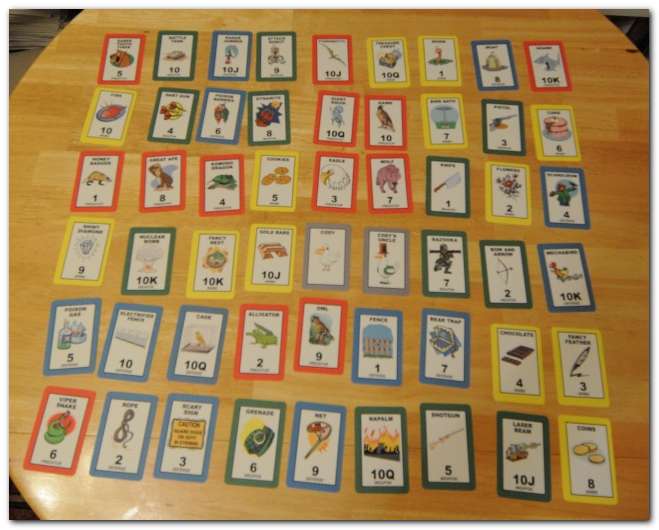
codycards.jpg

Let me know if you find it useful!


Non-core-python requirements: PIL image library

13992
Most importantly I agree that a fundamental flaw with the current system is the lack of clearly established value. So we should I think be looking at addressing that one way or another, whether it's using the approach you're suggesting here or something else.

yes.

what are your (and others') thoughts on the support-driven model that many open source projects use?

i have always had very negative gut-level reaction to this -- only because it seems to me to have the potential to end up where the coders get nothing and the marketing company which knows how to sell support services gets rich.  i know that in practice this doesn't tend to happen.. but it just makes me uneasy.

i think for some projects it may make a lot of sense.. though i'm not sure if it makes sense for desktop applications.  i think it does kind of encourage a phenomena one sees a lot in the open source community which is basically that the source is available but few people can get it to work without a lot of "support".  it's not too paranoid to imagine that making things easy to use is a pretty low priority if the basis for your financial support is people needing help figuring out how to use it.

but the middle ground here may again bring us back to the idea of updates.. and having donors get some benefit in terms of updates, ease of updating, etc.  as we've discussed on other threads.

one really interesting model that some open source companies have been adopting is where the newest version is not open source, but the open source version is always 6 months or 1 version behind, etc.  One could do the same thing with free vs. pay versions, where the previous version is always free, and the latest version is only for supporting members.

13993
Put much more concisely, the new idea is to frame the "work" involved as: Work performed to save money.

Start off with a high value for our product, and let them bring that down to an amount they are comfortable with (including $0) by asking them to do just a little bit of mental effort.

And "work" may be as simple as making the mental effort to actually understand the system of donating what you want.  Don't underestimate the mental cost of having to read and absorb this information and decide on an amount is.. It's non-trivial to many people unfamiliar with the idea.
13994
Perhaps I am conflating a couple of different goals.

Put in this new language, the current system attempts the following:

  • Attempts to make the easiest path the path of donating; but user must still go through substantial mental effort to determine the amount they should donate, and the value of the product.
  • Attempts to make the harder path not donating; though it is still easier to just download the software and use it until it asks you for a license key, etc.
  • I think it has some success.  And people who cannot afford to pay do not have to pay, and others can choose how much to pay.

The new idea attempts:
  • Make the easiest path actually PAYING some fixed suggested amount, and making this almost 0 mental effort; nothing to figure out, just click BUY.  The BUY path would also be the solution to commercial purchases.
  • Conveying a value of the product to all users to avoid them wrongly assigning a low value to it.
  • Making the harder path the one where they choose how much to donate, including zero.
  • Modifying this secondary path so that it gives us a chance to explain to them how and why they are getting such a bargain.
  • Take this secondary path opportunity to try to convince them to donate SOMETHING.
  • It might be that the secondary path would not require free users to do anything more complicated, unlike the current method.

Said more concisely, maybe a way to look at the change idea is that, in both scenarios there is an EASY path and a HARD path.

Currently, the EASY path is donating whatever you want; the HARD path is not donating.

The new idea is to make the EASY path making a purchase at a fixed price; the HARD path is choosing an amount to donate, including nothing. (maybe donating nothing is harder).

Explained in that way, the new approach sounds kind of mean :(

But on the other hand it is a much more MENTALLY CONSISTENT, COMMUNICATIVE and logical approach -- in that the EASIEST path involves the least mental effort, and explains the value of the software.  And the harder path involves more work but sets up the expectation of savings from doing the work requested.

I'm growing increasingly concerned that a major flaw of the current approach is that it starts people off assigning a very low perceived monetary value to the software, and then quickly confronts them with the need to perform some real mental effort in order to get the software.  Work that looks proportionately less attractive as the cost to them decreases (see my first post).  That was the point of my first post, that we have a catch-22 where the less they plan to spend, the less willing they are to perform the mental work to get it.

So the new approach tries to short circuit that put the user back on a more natural path where they can tradeoff mental effort for savings.

Anyway, just thinking out loud here.  Needs lots more cogitation.
13995
worstje,

I think that it's been shown very conclusively, over and over, in every domain, that the price labels put on products have *dramatic* effects on the perceived values of products.

People do *not* make rationale decisions about how much to pay for something based on it's innate qualities.

The very unintuitive reality is that there are many cases where people are more likely to buy the same item if it costs more.  And where people will choose an "objectively" worse product if it has a higher price.

These are the strange realities of human psychology..
13996
Deo,

Yes you are getting at my point -- changing the perspective of user so that they start off seeing it as a SALE that they are getting a good bargain on -- rather than having them start out saying this is worth $1 to me and so im not going to be willing to exert any effort to pay for it.

The starting point has to be some communication of the value and bargain they are getting.. And plain donationware may communicate the opposite -- it may bias users to think this is something of no value.

That's why i guess im suggesting changing to perhaps a model which looks more like a traditional software purchase, but with an alternate route that lets people get the software for free or for whatever they want to pay.


Here's a more concrete and maybe clarifying example.

Software costs $100.
OR you can fill out this quick survey and then pay what you want (including nothing), and tell us why you chose the amount to pay that you did.

Now we can see how the user will see that the value of the software is $X, but choose to expend a little more mental effort to pay what they want.

The end result is the same -- people choose how much to pay -- the difference is how they view the "work" they have to put in for that amount, and in escaping the catastrophic scenario where they decide that by definition being able to pay what they want means its not worth the effort.
13997
I was right with you all the way up to the


I didn't explain that part well..  Let me try to re-explain.

The main point I was trying to make is,

Offer a super quick straight-through pass to purchase at high price.  That will be the fastest and least-mental-effort path, no more choices to make and the value is set at $100.

And a link to "Learn more about how to get the software at a cheaper price or for free.."

That second page will require them to do some reading and thinking, to figure out if this approach is for them.. they will have to read how to divide up their donation, and how the site works, etc.

The goal is to do two things:
One is to tell them how much WE think the software is REALLY worth, so that they don't think of it as worth the lowest amount they can imagine.
The other is to make it easier to purchase at the full price than to do extra work to get it at a savings.

What it tries to avoid is the situation where:
  • Person reads that the software is donationware, concludes they are willing to pay $5 and thus that the VALUE is $5, and then decides it's not worth the effort to go through these steps to get a $5 piece of software.
  • Instead we want them to start off saying: This is a $100 value.. now how much mental effort am i willing to trade off to reduce the cost to almost zero.

13998
nice find  :Thmbsup:
13999
I had a bit of an epiphany the other day about why it's so hard to get people to donate for donationware software in the current environment, and it's related to purchase price vs purchase effort.

My hypothesis is the following:

When a person is considering whether to donate for a piece of software, they look at the AMOUNT THEY ARE PLANNING TO PAY and compare that to the WORK+RISK INVOLVED in paying.

If the amount of work far exceeds the amount they are planning to pay, they will not proceed.

IMPORTANT: Note that this is not a rational decision, as far as i can imagine.  But I hypothesize that it is the case.

If it's true, it just adds weight to the argument i've been making that the donationware community needs a savior, in the form of a kind of Universal App Store payment system, whereby *everyone* is set up to making small donations super-easily and safely with just a click of a button.

But if true, it also suggests something else:

The one way to get people to get over the hump and make the effort to donate, is to stop focusing on small donations -- since the smaller the donation, the more resistant someone will be to go through the effort to donate (under my hypothesis).  It means that a focus should be on providing enough value that the amount they are going to spend gets high enough to be perceived as worth while.

If it's true it means that letting people choose their own price to donate may in fact be counter-productive for most potential donors, because it will lead to a chain of reasoning where they conclude they should avoid the software because its "value" to them (in terms of how much they were going to donate) does not justify the work involved.


Now here is where things get interesting.. You might be able to solve this problem if you frame the "purchase" differently.  For example you might be able to say:
"Here is a piece of software.  The cost for it is $100.  BUT if you are willing to go through the trouble of paying via paypal and using a license key, you can have it for $5."

It's possible this would help to avoid the problem where the person first concludes that the "value" of the software is $5.. and therefore not worth the effort to pay for it.  If they view it as a $100 product which they are able to get so much cheaper with a little effort, that might solve the problem.


A more specific implementation of this would look like this:  On the program page is a super quick "Buy Now: $100".  And a link saying "Tell me how i can pay less (or nothing) for this product.."  and the link would take them to a page that let's them pay anything they want including nothing, as long as they are willing to read the instructions on how to proceed.


Thoughts?
14000
Looking nice..
There is a transparent version of that cody image somewhere i can try to find it, if you can use it.

Once you get it looking the way you want i'd like to see a version that is more focused on "Why you should donate to the author" rather that "What is donationcoder"

Maybe something like, at top instead of "DonationCoder Userpage" it might say "This is a Donationware Application"
With top text saying "This application is free for personal use, but the author strongly requests that you make a donation if you find it useful. Commercial inquiries welcome."

And then the main window could have headline "How Do I Donate?"
With text something like:
"Donating is safe and easy, and comes with some serious benefits!

The author of this program is part of the DonationCoder.com community -- and asks that you make a donation to to them if you find this program useful, in order to support it's continued development and support.

Blah blah more details here on how to send a donation directly to the author and other links.."
Pages: prev1 ... 555 556 557 558 559 [560] 561 562 563 564 565 ... 1515next