@SB - really interesting article. Didn't know some of that. Thx!

Ray knows he has something special. Over the years he has it appraised a bunch of times, and he hears English, Italian, Scotch, etc. Then it turns out its a match for a bass known to be an Amati in England. The bass becomes reputed to be a circa 1640 Amati.
Postscript: The Amati assertion has always been controversial. Ive talked to at least one guy who says the twin to Rays bass in England is now believed to be a Glassel, made in Marknukeurchen
*Mini very rational 40hz rant follows. Please feel free to ignore.*
So typical with orchestral basses.

The disputes that break out over exactly
what a given bass is.

My GF's Mom is a very good violinist who played with several local orchestras. She had (allegedly - although they were both appraised and blessed off as being genuine by some big name string instrument appraisers in New York City) a Ceruti (who was a famous student of Amati) and a Guarneri. They're both fine violins with lovely but very different characters. Not the most beautiful I've ever heard. But they're up there. Especially the Guarneri. However, I've heard some
modern instruments I've actually liked
better. And those had neither the fancy pedigree - nor the nose-bleed inducing price tags - her two violins had. And let's not even get started on the
bows - which are a whole other business and topic for debate!
I guess I just don't get it. Either when it comes to Cremona violins - or '57 Stratocasters for that matter. As long as something sounds good, is responsive, and plays well, I could care less
who made it...or
when...or
where. But that's me. Which is to say I'm a
working musician rather than an investor in rarities. Or an instrument collector.
Probably the only thing (besides transportation hassles) that I was actually glad to get away from, when I got away from playing string bass, was the mystique and nonsense surrounding the instrument itself. Sure, better instruments made by better makers (using better materials and construction methods) sounded better than those that were not. But I can't really see or hear anything that justifies some of the reputations or astronomical prices many of these "fine instruments" fetch. I have heard one or two (played by some famous players) that were amazing. But there weren't
that many. Certainly not enough of them to create the industry which exists to buy and sell these things.
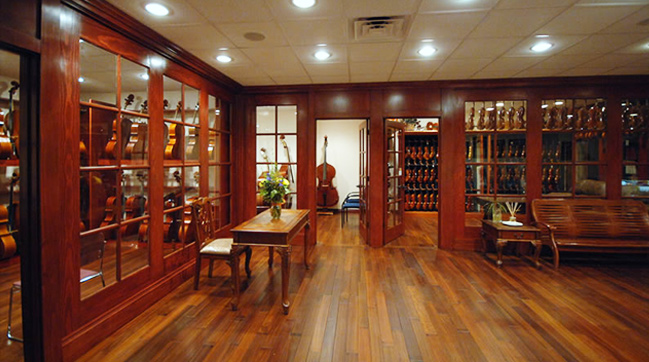
Sad thing is, that same nonsense is coming to the world of electric bass. There's already the 'collectable instrument' feeding frenzy starting to develop around the '60-'62 Fender Jazz and '58-'60 Fender Precision basses along with Gibson Thunderbirds from the early 60s...
I mean what is with these people? These are
mass-produced
manufactured instruments. In the case of Leo Fender's instruments, they were acknowledged (by Leo himself) to be
designed to be as easy and cheap to manufacture as was humanly possible. Even those vintage paint jobs so prized by Fender collectors were the result of his using automotive paints purchased in odd lots from a company that was conveniently located just down the road from the Fender factory. There's a half-joke at Fender that says if house paint was as readily available, and a nickel cheaper a gallon, Leo would have used
that instead.
Maybe I'll follow Carol's lead and just switch to cello.

In the case of Ray Brown, I think it wasn't so much the bass itself as it was the bass + Ray Brown. Because the "thing" isn't the instrument (which is just an inert pile of metal, wood, and potential) OR the player (which is heap of DNA, biomass, and spirit) but the
combination that really makes whatever magic there is.

Ok, I'm done! Carry on.


 Recent Posts
 )
)


