DonationCoder.com forum
 
Read-only archive. This is a static copy of the DonationCoder.com forum. Reading and searching work as before; logging in, posting and private messages do not.
Archive of 2026-10-21 · About this archive · Main site

Last post Author Topic: Hard Drive electrical failure... trash it?  (Read 34,986 times)

4wd

  • Pedantic Old Bastard
  • Supporting Member
  • Joined in 2006
  • **
  • Posts: 5,652
    • Coding Snacks
Re: Hard Drive electrical failure... trash it?
« Reply #25 on: September 09, 2008, 08:06 AM »
So how do you convert these charts (in watt) into volts and amperes ?

NOTE: Only applicable to a regulated DC supply, (AC power is a different beast altogether).

P = V * I

Power (in Watts) = Voltage (in Volts) * Current (in Amps)

therefore:

Current = Power/Voltage

2.5" drives run off of +5V, (no 12V required), so using the first drive listed in that chart, (Fujitsu MHV2200BT), for example:

Current = 2.2/5 = 0.44A = 440mA

It would lead you to believe that running that drive would be fine off of one USB port.

Wrong.

The time when most current is drawn is at drive spin-up, if you go to Fujitsu's own specs for the MHV2200BT, you'll see that spin-up current is rated at 0.9A maximum - just 100mA within the combined limit of two USB ports.

Personally, I take anything I read on Toms Hardware as less than reliable, they're only interested in power usage after the drive has spun-up and stabilised.  Being an ex-telecommunications technician and a electronics hobbyist, I always much rather look at a spec sheet.

My mate has an external 2.5" HDD that he uses, he taped up one of the USB A plugs because all the PCs he plugged it into ran it fine on just one - when he tried to do it on my PC I told him to use both or p*ss off  :D

BTW, in case you use an external USB hub please be aware that even though each USB port can supposedly supply 0.5A, unless it is externally powered you are limited to a total of 0.5A for ALL the ports on it because it is still only getting it's power from one PC USB port.
"I will not follow where the path may lead, but I will go where there is no path, and I will leave a trail." - Muriel Strode, 1903
« Last Edit: September 09, 2008, 08:18 AM by 4wd »

Armando

  • Charter Member
  • Joined in 2005
  • ***
  • Posts: 2,727
    • Coding Snacks
Re: Hard Drive electrical failure... trash it?
« Reply #26 on: September 09, 2008, 10:45 AM »
Very interesting 4wd. Thanks a lot for sharing your knowledge and experience.  :up:
"I suppose it can be said that I'm an absent-minded driver. It's true that I've driven through a number of red lights on occasion, but on the other hand, I've stopped at a lot of green ones but never gotten credit for it."
Glenn Gould

Edvard

  • Coding Snacks Author
  • Charter Honorary Member
  • Joined in 2005
  • ***
  • Posts: 3,027
    • Participated in NANY Challenge Once
    • Coding Snacks
    • Linux User
Re: Hard Drive electrical failure... trash it?
« Reply #27 on: September 09, 2008, 04:22 PM »
@4wd:
Quote
Switchmode PSUs really require a load in order to regulate correctly - therefore you'll need to plug it into a HDD before you can accurately measure the voltage.
Hmm... Good point. I wonder what would be required for a dummy loaded test rig?
Quote
We are talking about a HDD.

A normal HDD doesn't run on AC, (and one diode is not sufficient to fully rectify it anyway), and a HDD doesn't need a 0.6V voltage drop, which is only relevant for generic silicon diodes - it could be from approx. 0.2-0.7V depending on diode type, (discounting zener diodes).
Right. I noticed there appeared to be two diodes there, which is not very efficient nor effective, but I have seen setups like that whose duty was to rectify one last time to eliminate as much PS line noise as possible. I have also done this for wall-wart powered audio gear, as those things tend to be noisier than they need to.
Then again, you are correct, this is a HDD, not medical equipment or hi-fi audio.
Also correct on the diode type: Germanium diodes run in the lower .3v range (touchy little devils, those...) and LED's can run from .7 to .11v depending on color and power.
Quote
But personally, I wouldn't bother replacing the diode.  Remove it, power it up on a real ATX PSU, get your data off and then toss it if you don't want to live with it like that.
I agree. But wouldn't you want to bridge the diode pads after removing?
All children left unattended will be given a mocha and a puppy.

Armando

  • Charter Member
  • Joined in 2005
  • ***
  • Posts: 2,727
    • Coding Snacks
Re: Hard Drive electrical failure... trash it?
« Reply #28 on: September 09, 2008, 08:56 PM »
quote]But personally, I wouldn't bother replacing the diode.  Remove it, power it up on a real ATX PSU, get your data off and then toss it if you don't want to live with it like that.
I agree. But wouldn't you want to bridge the diode pads after removing?
[/quote]

So does that mean just... removing it... like with tweezers?  And not doing anything else except plug the HD? I must be misunderstanding something, am I not?
"I suppose it can be said that I'm an absent-minded driver. It's true that I've driven through a number of red lights on occasion, but on the other hand, I've stopped at a lot of green ones but never gotten credit for it."
Glenn Gould

4wd

  • Pedantic Old Bastard
  • Supporting Member
  • Joined in 2006
  • **
  • Posts: 5,652
    • Coding Snacks
Re: Hard Drive electrical failure... trash it?
« Reply #29 on: September 10, 2008, 04:37 AM »
@4wd:
Quote
Switchmode PSUs really require a load in order to regulate correctly - therefore you'll need to plug it into a HDD before you can accurately measure the voltage.
Hmm... Good point. I wonder what would be required for a dummy loaded test rig?

Normally a HDD ;)  Come on, you should be able to find an old HDD.  Hard rubbish collection when people throw out their old 286's with 20MB HDDs.  Visit your local tip.  Visit the local PC shop.  Tell your girlfriend that size does matter and she'll need to buy a bigger HDD  :D
Quote
Quote
We are talking about a HDD.

A normal HDD doesn't run on AC, (and one diode is not sufficient to fully rectify it anyway), and a HDD doesn't need a 0.6V voltage drop, which is only relevant for generic silicon diodes - it could be from approx. 0.2-0.7V depending on diode type, (discounting zener diodes).

Right. I noticed there appeared to be two diodes there, which is not very efficient nor effective, but I have seen setups like that whose duty was to rectify one last time to eliminate as much PS line noise as possible. I have also done this for wall-wart powered audio gear, as those things tend to be noisier than they need to.

Actually, the only way to eliminate line noise is to use capacitance or inductance.  You'll probably find that the diodes were there for protection against reverse power connection.  Feeding DC, (or AC), into a full-wave bridge rectifier will always produce + and - on the correct terminals allowing anything connected to work.  You've then got a voltage drop across two diodes to take into account.

Quote
Quote
But personally, I wouldn't bother replacing the diode.  Remove it, power it up on a real ATX PSU, get your data off and then toss it if you don't want to live with it like that.
I agree. But wouldn't you want to bridge the diode pads after removing?

Aaahh, I now see where there is confusion.

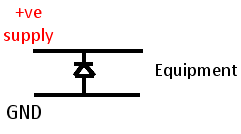
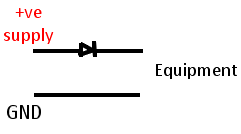
Using just a single diode there is basically two methods of guarding against reverse power connection.

Method 1: You're referring to probably the most common form: a diode connected in series with the +ve supply rail as per this diagram:

[attach]
"I will not follow where the path may lead, but I will go where there is no path, and I will leave a trail." - Muriel Strode, 1903
« Last Edit: September 10, 2008, 01:13 PM by 4wd »

Edvard

  • Coding Snacks Author
  • Charter Honorary Member
  • Joined in 2005
  • ***
  • Posts: 3,027
    • Participated in NANY Challenge Once
    • Coding Snacks
    • Linux User
Re: Hard Drive electrical failure... trash it?
« Reply #30 on: September 10, 2008, 03:35 PM »
Quote
Quote
Hmm... Good point. I wonder what would be required for a dummy loaded test rig?
Normally a HDD   Come on, you should be able to find an old HDD.
Well, sure, but I'm talking a rig, like with test point lugs and places to clip to, etc. *sigh*. I guess the old-school dies hard.
Quote
Actually, the only way to eliminate line noise is to use capacitance or inductance.
Good gravy, I've gotten rusty... Yes, you're right. I've always added an extra rectification stage for insurance and I don't mind the extra voltage drop as I've found the voltage out of most wall-warts to be on the high side anyways.

Regarding the diodes, you are right again. I clean forgot about HDD's having 2 voltage supplies.
Geez, I better heat up the old soldering iron before I shoot my mouth off again.

Armando, listen to 4wd. Apparently I've forgotten almost all things hardware since I took up Linux  :-[

All children left unattended will be given a mocha and a puppy.

4wd

  • Pedantic Old Bastard
  • Supporting Member
  • Joined in 2006
  • **
  • Posts: 5,652
    • Coding Snacks
Re: Hard Drive electrical failure... trash it?
« Reply #31 on: September 10, 2008, 07:57 PM »
Quote
Quote
Hmm... Good point. I wonder what would be required for a dummy loaded test rig?
Normally a HDD   Come on, you should be able to find an old HDD.
Well, sure, but I'm talking a rig, like with test point lugs and places to clip to, etc. *sigh*. I guess the old-school dies hard.

Pretty much all the PSUs supplied with external enclosures are sealed plastic units that output to:
(a) 4 pin round connector, (eg. CoolerMaster 3.5" X-Craft enclosures),
(b) 4 pin molex connector, (eg. the USB -> SATA/IDE converters),
(c) a common DC plug that supplies just +12V, (eg. like my D-Link DNS-313).

You could make a simple breakout box for (b) and (c) but to make one for (a) you'd need to find a supplier of matching plugs/sockets or trash an existing enclosure.

All in all, easier to just plug in a HDD and measure off of its pins.
Assuming you have a steady hand of course....then again, if you haven't you really shouldn't be doing component level SMD work  ;)

Unfortunately, old-school test rigs, (at least for non-specialised work), went the way of the dodo when the planet moved to the throwaway model of consumerism.  The majority of repair work for consumer items is now board level, (swap the whole board), or total replacement.

All decent, well-designed equipment will provide test points on the actual boards for voltage/waveform measurements, otherwise you usually have to make do with sticking your test probes onto component legs and hoping you don't slip.

BTW, cut the old school stuff - I'm 9 years older than you  >:(  :mad:  :'(  :(  :)  :D  :P

Quote
Regarding the diodes, you are right again. I clean forgot about HDD's having 2 voltage supplies.

Technically, SATA HDDs can actually have three voltage supplies.  There is provision for +3V3 on the SATA power connector, (the three pins on the right in Amando's picture), however I haven't seen a HDD that uses it yet.
But if you do find yourself with one then powering it via a molex->SATA adapter cable isn't an option.
"I will not follow where the path may lead, but I will go where there is no path, and I will leave a trail." - Muriel Strode, 1903
« Last Edit: September 10, 2008, 08:08 PM by 4wd »

Armando

  • Charter Member
  • Joined in 2005
  • ***
  • Posts: 2,727
    • Coding Snacks
Re: Hard Drive electrical failure... trash it?
« Reply #32 on: September 11, 2008, 03:31 AM »
So my amended directions would be:
1. Remove it.
2. Measure the resistance between the two pads it came off.  If it reads zero then the HDD is not worth the trouble.
    NOTE: There will be some resistance just hopefully not a dead short.
3. Connect it to a REAL ATX PSU as found in a desktop PC.  DO NOT connect the data cable - just the power cable.
4. Turn it on.  If it spins up let it run for 30 minutes.  If it doesn't spin up, turn it off immediately and forget about it.
5. Assuming it spun up, turn it off.  Connect the data cable, turn it back on and see if it's identified at the POST screen.  If it is, you might be lucky and get your data off of it, (assuming the power spike didn't scramble everything).

Thanks!  :)  I'll find a used ATX PSU somewhere... And, after removing the diode, I'll just plug it in and see. If it spins up I'll see what I'll do then...

Thanks again 4ws and Edvard. That's all very very informative! That's one field I certainly know nothing (0) about.
"I suppose it can be said that I'm an absent-minded driver. It's true that I've driven through a number of red lights on occasion, but on the other hand, I've stopped at a lot of green ones but never gotten credit for it."
Glenn Gould

Shades

  • Member
  • Joined in 2006
  • **
  • Posts: 2,954
Re: Hard Drive electrical failure... trash it?
« Reply #33 on: September 11, 2008, 04:42 AM »
Ah well....live and learn.

Don't try this with high voltages though...it takes a whole lifetime to learn and before you know it the study course is over while saying the mantra of those right about to go on the travel beyond return.

That mantra would be: 'oops' or 'ohoh' (clinical studies still have not lead to a decisive answer on that one)  ;D
The easy path is usually downhill...

4wd

  • Pedantic Old Bastard
  • Supporting Member
  • Joined in 2006
  • **
  • Posts: 5,652
    • Coding Snacks
Re: Hard Drive electrical failure... trash it?
« Reply #34 on: September 11, 2008, 05:05 AM »
That mantra would be: 'oops' or 'ohoh' (clinical studies still have not lead to a decisive answer on that one)  ;D

I think I read that study but the most used mantras were another pair of four letter words  :Thmbsup:
"I will not follow where the path may lead, but I will go where there is no path, and I will leave a trail." - Muriel Strode, 1903

Shades

  • Member
  • Joined in 2006
  • **
  • Posts: 2,954
Re: Hard Drive electrical failure... trash it?
« Reply #35 on: September 11, 2008, 05:40 AM »
Just trying to not p..s off the censor/moderator(s) from this forum  ;)
The easy path is usually downhill...

Original address: https://www.donationcoder.com/forum/index.php?topic=14729.0