The last distribution I had installed was Fedora 7, and after getting a new videocard, I reinstalled Ubuntu. For the unsuspecting newbie like myself, after you've installed a half dozen distros from Debian to Fedora to Mandriva to MEPIS to PCLinuxOS to Ubuntu, the first thing you notice is that they all essentially look the same. That's because they're using one of two desktop environments (shells in Windows lingo) — Gnome or KDE. If I didn't go any further than appearances, then it doesn't matter which distro is underneath that pretty UI. But the differences can be either subtle or significant depending on how you use your system, and what type of system you're able to install GNU/Linux onto.
After booting Ubuntu the first time, I installed the updates automatically. However, Ubuntu didn't recognize my videocard despite allowing me to download the specific driver for it. Fonts were grainy, and even after adjusting their settings, they still looked bad. After running the update manager, the system needed to reboot. When I rebooted, Ubuntu froze. Here's the complex solution which did not work for me. (http://ubuntuforums.org/showthread.php?t=461215) I ended up reinstalling it two more times to the same result. Not wanting to spend an entire weekend or longer trying to fix it, I surrendered. Our friend Gothi(c) predicted this common problem in the last part of this serial!
[attach linux-problem01.png]


 i must be like light years behind as only recently i found out that GNU/Linux doesn't support dial-up modems (serial or USB).. instead you have make a trip to




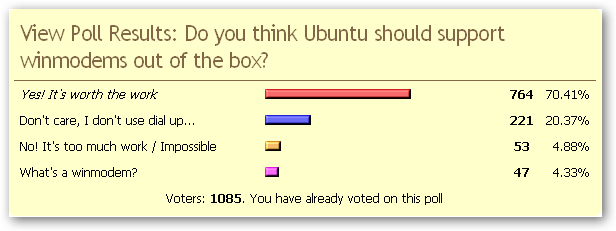
 i also found this thread that advocates native support for winmodems and i duly voted for it..