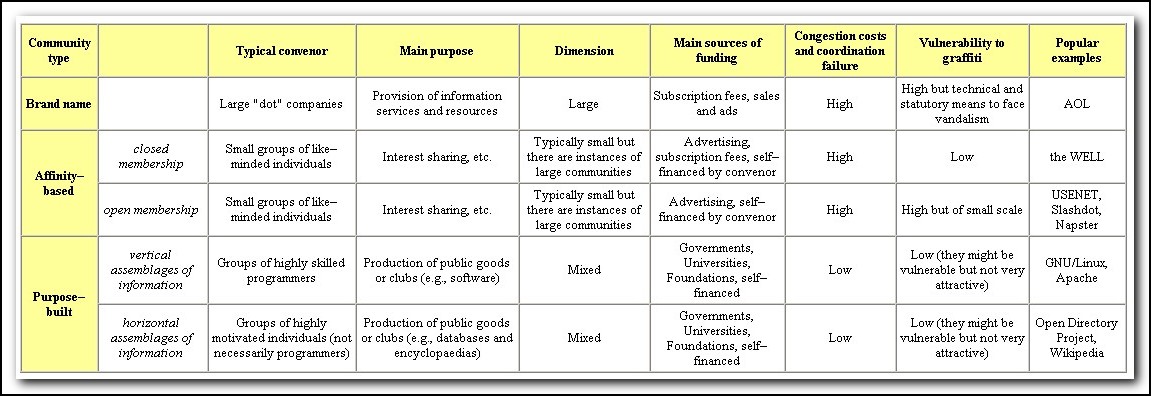
This article by Andrea Ciffolilli looks into economics of virtual communities. Based on example of Wikipedia, he tries to understand how these communities can be far more efficient in producing public goods than the traditional institutional solutions. It seems quite relevant to the dc community.
http://firstmonday.org/issues/issue8_12/ciffolilli/index.html
http://firstmonday.org/issues/issue8_12/ciffolilli/index.html
Quote
Phantom authority, self–selective recruitment and retention of members in virtual communities: The case of Wikipedia by Andrea Ciffolilli
Virtual communities constitute a building block of the information society. These organizations appear capable to guarantee unique outcomes in voluntary association since they cancel physical distance and ease the process of searching for like–minded individuals.
In particular, open source communities, devoted to the collective production of public goods, show efficiency properties far superior to the traditional institutional solutions to the public goods issue (e.g. property rights enforcement and secrecy).
This paper employs team and club good theory as well as transaction cost economics to analyse the Wikipedia online community, which is devoted to the creation of a free encyclopaedia. An interpretative framework explains the outstanding success of Wikipedia thanks to a novel solution to the problem of graffiti attacks — the submission of undesirable pieces of information. Indeed, Wiki technology reduces the transaction cost of erasing graffiti and therefore prevents attackers from posting unwanted contributions.
The issue of the sporadic intervention of the highest authority in the system is examined, and the relatively more frequent local interaction between users is emphasized.
The constellation of different motivations that participants may have is discussed, and the barriers–free recruitment process analysed.
A few suggestions, meant to encourage long term sustainability of knowledge assemblages, such as Wikipedia, are provided. Open issues and possible directions for future research are also discussed.