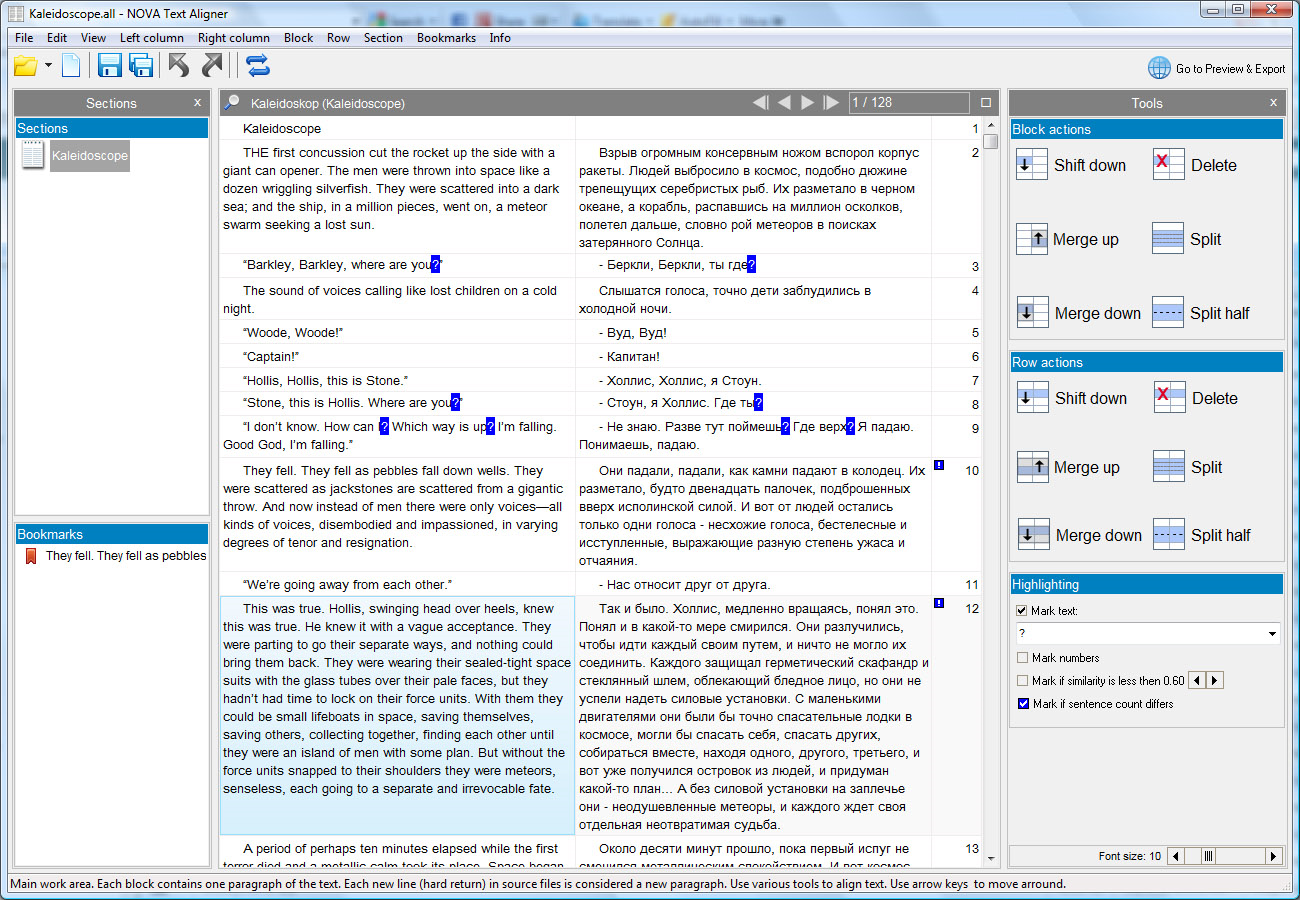
Last comment on Bits for that: http://www.bitsdujour.com/software/nova-text-aligner-2/in=search-for-software :
"The page linked as "Website" above goes into length criticising the competition, stating (my wordings here) that the automatisms there (sentences, paragraphs) do it wrongly, and then you must do it manually anyway, and thus, with Nova, which forces you to do it manually to begin with, that's the real way to do it. The page states this manual way of doing it in Nova is a simple as it gets, but it doesn't tell us HOW this process is facilitated by Nova; also, and with all due respect, I would like to know WHERE the alleged advantage of Nova (except for the price of a mere 10$ of course) over the competition lies, since logically, even if the manual processing in Nova is easy/simple:
If some of the automated competitors do 8 new paragraph dividers right and 1 wrong, I immediately see this on screen, from the faulty length - this being a big difference with for example OCR where I would need to read the whole text attentively, in order to look up processing errors -, I put the mouse cursor there, then either delete the faulty paragraph divider, or insert the missing one - also, I firmly believe that such a mistake will not occur once a page with the automated competition but perhaps once every third or fourth page or the like -; at the same time, with Nova, I must put in all the 9 dividers of my example manually, be that easy or not.
So from what I conceive, Nova just seems to be grossly inferior to its competitors and does not present the alleged - and NOT explained - advantage over its competition at all, but I'd welcome any pertinent information.
Would it be too harsh to say that from what I read from the current text on the linked page, it seems that text tries to turn a big disadvantage into a feigned advantage, hoping readers will not grasp the amount of additional work they will have to do in Nova, over what they would have to do with some competitor's tool? Fact is, I read that text with interest and then had to realize it didn't answer any of my questions but just built up something I felt like being allegedly illusionary expectations in order to blur my discernment."
Referring to this page: https://nova-text-aligner.soft112.com/ : "NOVA Text Aligner is a tool designed to make manual text alignment as easy and simple as possible. It doesn't use any automatic paragraph or sentence alignment algorithms. Why? Because there are things where a human can not be replaced and parallel text editing is such a thing." and blah blah blah on that matter - no comment from the developer.
Please note the logical bomb in the little text cited: He states that there is no alignment (!) automatism in his tool, and for justifying this, he claims "a human can not be replaced" in "parallel text EDITING" (my formatting): In order to justify his not having done his homework for step 1, he pretends no tool of this kind could help with step 2, and you might agree that these steps are clearly distinct, for once.
Would you buy software from a developer who's so deeply at war with logic? Or am I too harsh here? ;-)