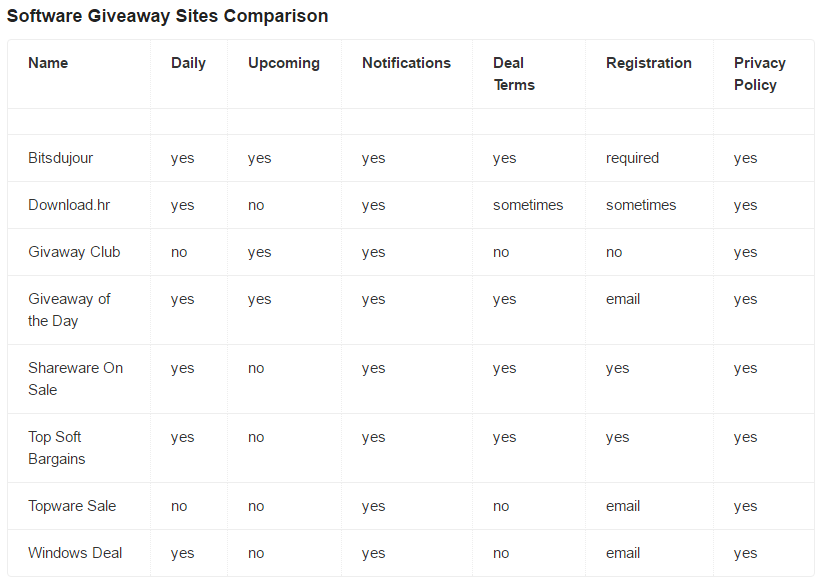
Ghacks looks at software giveaway sites
« on: July 27, 2016, 06:30 PM »

 Topic: Ghacks looks at software giveaway sites (Read 20,844 times)


I have bookmarked it
It would be good if we can automate search on all these links for deal of the day and present one page with it. DC snack, anyone ?
Regards,
Anand

Short of that there is a pretty good round-up updated several times a week on Giveaway Radar
Also the Android page 

Now if I can get time enough each day to look through the pages


Short of that there is a pretty good round-up updated several times a week on Giveaway Radar
This doesn't mention the reason that I quit looking at GAoTD - it wouldn't work on 64-bit Windows.
For example, on BDJ, there are 6 entries. However, Giveaway Radar says No useful Bits today, too bad !
For example, on BDJ, there are 6 entries. However, Giveaway Radar says No useful Bits today, too bad !
In all that text at the top it says something about the fact that they don't claim to check all the sites all the time. I have the giveaway sites I follow in a bookmark folder along with Radar. After I read the Radar page then I go glance at all them them in turn. I don't do computer games so that side of it I just skip.

So not knowing their criteria, it makes it difficult to see if you need to visit the sites in question. That's my concern. Why use an aggregation site if it doesn't aggregate?Yes, eggsaggerly.
___________________________
From: http://www.openculture.com/2016/04/carl-sagan-presents-his-baloney-detection-kit-8-tools-for-skeptical-thinking.html
PDF: http://www.inf.fu-berlin.de/lehre/pmo/eng/Sagan-Baloney.pdf - "The Fine Art of Baloney Detection".
In one chapter of his book, “The Fine Art of Baloney Detection,” Sagan laid out his method, proposing what he called “A Baloney Detection Kit,” a set of intellectual tools that scientists use to separate wishful thinking from genuine probability. Sagan presents the contents of his kit as “tools for skeptical thinking,” which he defines as “the means to construct, and to understand, a reasoned argument and—especially important—to recognize a fallacious or fraudulent argument.” You can see his list of all eight tools, slightly abridged, below. These are all in Sagan’s words:
Wherever possible there must be independent confirmation of the “facts.”
Encourage substantive debate on the evidence by knowledgeable proponents of all points of view.
Arguments from authority carry little weight — “authorities” have made mistakes in the past. They will do so again in the future. Perhaps a better way to say it is that in science there are no authorities; at most, there are experts.
Spin more than one hypothesis. If there’s something to be explained, think of all the different ways in which it could be explained. Then think of tests by which you might systematically disprove each of the alternatives.
Try not to get overly attached to a hypothesis just because it’s yours. It’s only a way station in the pursuit of knowledge. Ask yourself why you like the idea. Compare it fairly with the alternatives. See if you can find reasons for rejecting it. If you don’t, others will.
If whatever it is you’re explaining has some measure, some numerical quantity attached to it, you’ll be much better able to discriminate among competing hypotheses. What is vague and qualitative is open to many explanations.
If there’s a chain of argument, every link in the chain must work (including the premise) — not just most of them.
Occam’s Razor. This convenient rule-of-thumb urges us when faced with two hypotheses that explain the data equally well to choose the simpler. Always ask whether the hypothesis can be, at least in principle, falsified…. You must be able to check assertions out. Inveterate skeptics must be given the chance to follow your reasoning, to duplicate your experiments and see if they get the same result.
"Nullius in verba/verbo." Literally, "Take nobody's word for it; see for yourself"
So not knowing their criteria, it makes it difficult to see if you need to visit the sites in question. That's my concern. Why use an aggregation site if it doesn't aggregate?
 .
Original address: https://www.donationcoder.com/forum/index.php?topic=42868.0