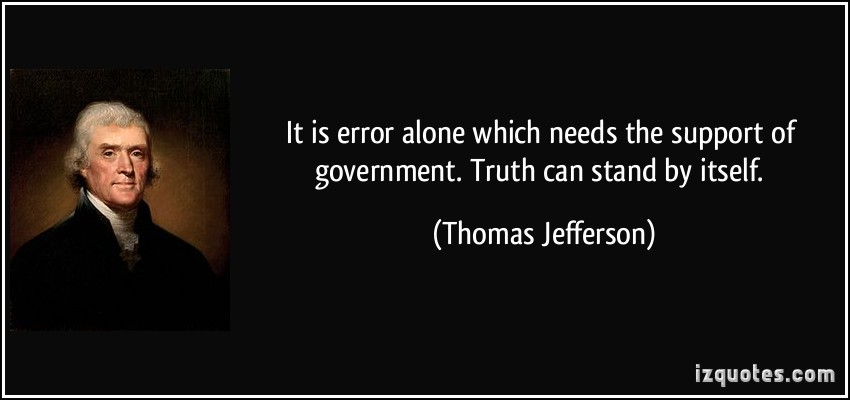
Is anyone other than myself concerned about Google now determining what is 'true'?
One article:
http://www.abc.net.au/news/2015-03-06/sparrow-google-seeks-a-higher-truth-but-will-struggle-to-get-it/6285054
More at the link.
This is pretty disturbing. If they do implement it, I will most certainly look elsewhere and avoid Google.
Again from the article:
I think that highlights an important problem -- "a political problem, not a technical one".
Politics? So, now searching for information has become political?
Hello!?! Thought police anyone?!?
When someone wants to find out about "hollow earth" or "flat earth", then what happens?
How about "economics in the 20th century"? What then? Keynes? Rothbard? Hayek? Marx?
UFOs and aliens?
Einstein's field equations and torque? (Yes - this is a real thing.)
Just for the sake of living up to my user name here, and for a hat tip to those educated in the classics, I would like to leave this post with a little tidbit...
Disclaimer
Yeah... I know... this could quickly degenerate into a pissing match, and get sent to the basement, but I'm pretty much counting on people's ability to be adults and discuss the meta issue of Google determining what is "true" vs. what truth is. So... for the love of Pete... Please... let's stick to the big issue and not get caught up in details. Examples are great, but let's not dwell on our agreement over examples.
One article:
http://www.abc.net.au/news/2015-03-06/sparrow-google-seeks-a-higher-truth-but-will-struggle-to-get-it/6285054
Quote
Google seeks a higher truth, but will struggle to get it
Google has outlined a method to rank search results by factual accuracy, but if the hope is to dispel mistruths in political and social debates it's unlikely to work. In fact, it could contribute more to the problem, writes Jeff Sparrow.
Researchers at Google have outlined a new method of ranking search results on the basis of the factual accuracy of content.
A new paper by the search giant's scientists suggests that the number of incorrect facts on a particular page could be tallied, using that as a proxy for trustworthiness. In theory, popular but unreliable sites would then drop down the listings so that your results would be dominated by sources you could trust.
Not surprisingly, the concept has not been universally acclaimed. As one writer put it: "The idea raises concerns as to how exactly the fact checking would take place, and whether it would impact controversial or alternative stances on various issues, which could be a blow to freedom of speech and diversity of opinions online."
More at the link.
This is pretty disturbing. If they do implement it, I will most certainly look elsewhere and avoid Google.
Again from the article:
Quote
To put it another way, the willingness of people to give vaxers and birthers a hearing is a political problem, not a technical one, and so it can't be solved by rejigging a search algorithm.
I think that highlights an important problem -- "a political problem, not a technical one".
Politics? So, now searching for information has become political?
Hello!?! Thought police anyone?!?
When someone wants to find out about "hollow earth" or "flat earth", then what happens?
How about "economics in the 20th century"? What then? Keynes? Rothbard? Hayek? Marx?
UFOs and aliens?
Einstein's field equations and torque? (Yes - this is a real thing.)
Just for the sake of living up to my user name here, and for a hat tip to those educated in the classics, I would like to leave this post with a little tidbit...
Quote from: John 18:38
"What is truth?" retorted Pilate. With this he went out again to the Jews gathered there and said, "I find no basis for a charge against him."
About Pilate
Pilate was a well educated man, and understood the writings of the "greats". This was basically all Greek skepticism, which is the foundation of the modern world. i.e. Skepticism was and is the dominant philosophical school of thought, although there are some serious bastardisations and perversions. But that's best left to another discussion. 
So, Pilate's response with "What is truth" is a direct reflection of his education and understanding of philosophy. (That's a circular argument, but it's enough for anyone to do their own checking on it, and it needed to be made explicit for there to be an actual purpose to this footnote that could have been skipped if I'd simply avoided the Pilate quote... but since it's such a cool quote, I simply couldn't avoid including it!)
So, Pilate's response with "What is truth" is a direct reflection of his education and understanding of philosophy. (That's a circular argument, but it's enough for anyone to do their own checking on it, and it needed to be made explicit for there to be an actual purpose to this footnote that could have been skipped if I'd simply avoided the Pilate quote... but since it's such a cool quote, I simply couldn't avoid including it!)