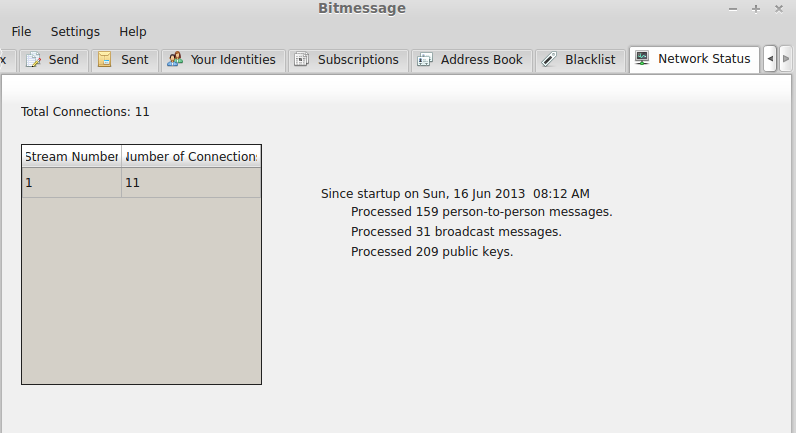
Just ran into this interesting item over at the CoinDesk website. It discusses a new method of implementing a decentralized e-mail system that encrypts and secures message content - and heavily obscures the sender/receiver addresses as well.
Sounds like a marriage made in heaven.
It's still too early in the game to see if this takes off. Or (more likely) if it's permitted to take off.
There's more to read at the Bitmessage wiki (https://bitmessage.org).
There's also an official whitepaper, written by Jonathan Warren, that gets into the nitty-gritty of how it works. You can download your own copy from this link.
This could get interesting...
[attach]
Sounds like a marriage made in heaven.
Quote
We’ve seen the impact that Bitcoin can have on the future of payments. But money is not the only area that the movement is influencing. Bitmessage is a protocol that implements some of the ideas of Bitcoin into communications.
Given the pressure on technology companies to cooperate with governments regarding services like email, those looking for a private way to communicate could find Bitmessage’s concept quite interesting.
We live in a time where cloud computing has become the norm for our digital services. That means that a lot of our information is actually stored in data centers scattered around the globe. This has provided us with convenience in the form of access to our data from anywhere. At the same time, however, we are losing a sense of control and security over our communications whether it is via chat, email or on social networks.
Enter Bitmessage:
Bitmessage is like Bitcoin in that it is a decentralized, peer-to-peer protocol. Unlike using an add-on component for email similar like Pretty Good Privacy (PGP), Bitmessage is a unified system that encrypts every message. The whole point of the platform is to keep your communications secure. And on top of that, it keeps secure the members of the communication: not only is the content of messages protected, but the sender and receiver of those messages is kept secret as well.
According to the official Bitmessage whitepaper, even those who use encryption standards such as PGP find it an overwhelming process. In this way, one can think about Bitmessage as a decentralized email server.
<more>
It's still too early in the game to see if this takes off. Or (more likely) if it's permitted to take off.
There's more to read at the Bitmessage wiki (https://bitmessage.org).
There's also an official whitepaper, written by Jonathan Warren, that gets into the nitty-gritty of how it works. You can download your own copy from this link.
This could get interesting...
[attach]