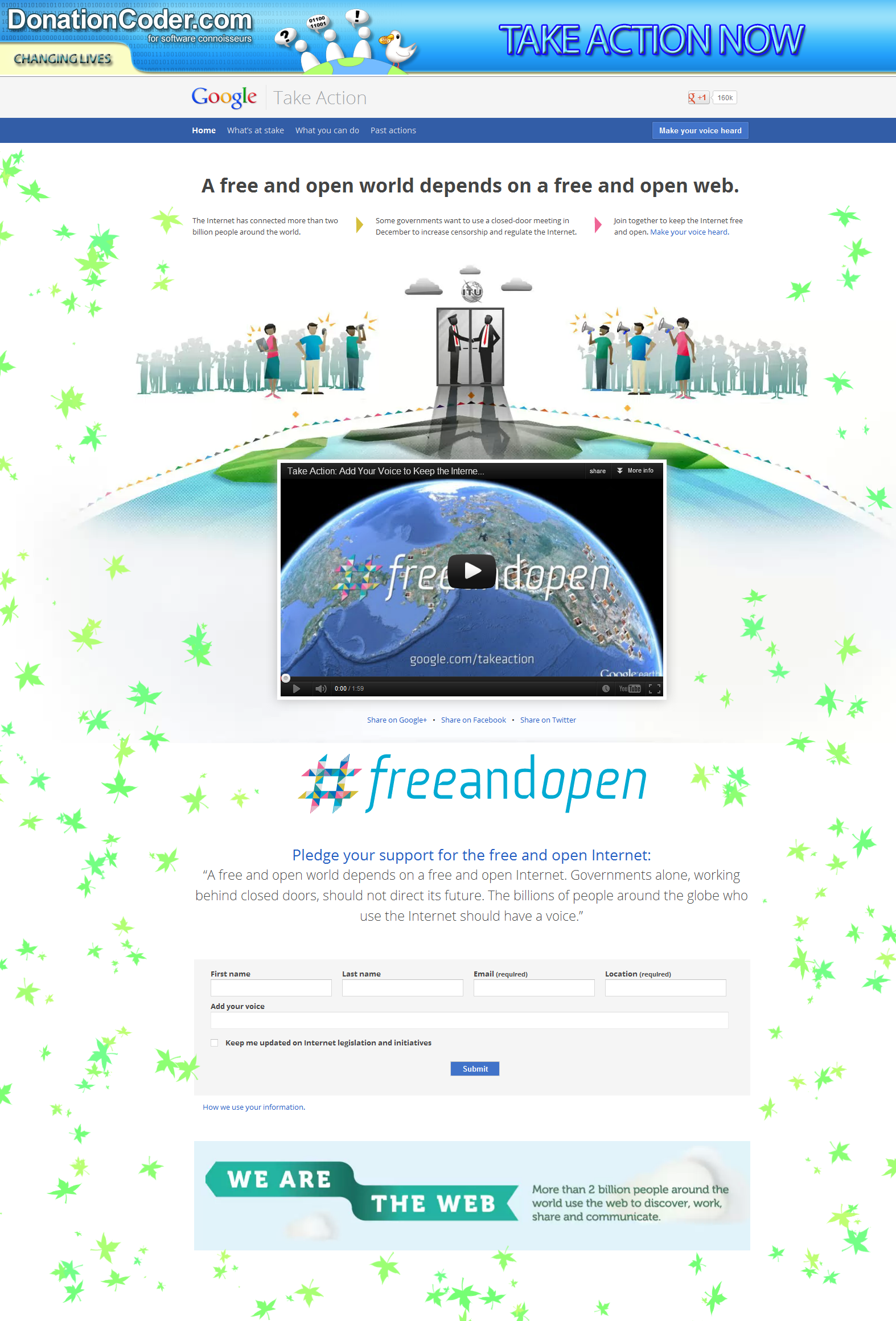
A free and open world depends on a free and open web.
« on: November 23, 2012, 07:09 PM »

 Topic: A free and open world depends on a free and open web. (Read 4,755 times)


Is Internet access and online freedom of expression a basic human right? The United Nations’ Human Rights Council unanimously backed that notion in a resolution on Thursday.
The resolution says that all people should be allowed to connect to and express themselves freely on the Internet. All 47 members of the Human Rights Council, including notoriously censorship-prone countries such as China and Cuba, signed the resolution.
China’s support for the resolution came with the stipulation that the “free flow of information on the Internet and the safe flow of information on the Internet are mutually dependent,” as Chinese delegate Xia Jingge told the Council in a sign that the country isn’t about to tear down the so-called “Great Firewall of China.”
The concept was first affirmed by a U.N. agency, the International Telecommunications Union (ITU), in 2003. The ITU has recently come under fire after rumors arose that member states were preparing proposals to give the United Nations more control over the Internet ahead of a December conference. The ITU has rejected many of those claims.
Internet access as a human right has since been supported by several of the Internet’s most well-known proponents, including Tim Berners-Lee, the inventor of the World Wide Web.
“[It's] an empowering thing for humanity to be connected at high speed and without borders,” Berners-Lee told the BBC in April of last year while reflecting on the Internet’s role in the Arab Spring uprisings.
Related: http://mashable.com/2012/07/06/internet-human-right/QuoteIs Internet access and online freedom of expression a basic human right? The United Nations’ Human Rights Council unanimously backed that notion in a resolution on Thursday.
The resolution says that all people should be allowed to connect to and express themselves freely on the Internet. All 47 members of the Human Rights Council, including notoriously censorship-prone countries such as China and Cuba, signed the resolution.
China’s support for the resolution came with the stipulation that the “free flow of information on the Internet and the safe flow of information on the Internet are mutually dependent,” as Chinese delegate Xia Jingge told the Council in a sign that the country isn’t about to tear down the so-called “Great Firewall of China.”
The concept was first affirmed by a U.N. agency, the International Telecommunications Union (ITU), in 2003. The ITU has recently come under fire after rumors arose that member states were preparing proposals to give the United Nations more control over the Internet ahead of a December conference. The ITU has rejected many of those claims.
Internet access as a human right has since been supported by several of the Internet’s most well-known proponents, including Tim Berners-Lee, the inventor of the World Wide Web.
“[It's] an empowering thing for humanity to be connected at high speed and without borders,” Berners-Lee told the BBC in April of last year while reflecting on the Internet’s role in the Arab Spring uprisings.
Article 29.
(1) Everyone has duties to the community in which alone the free and full development of his personality is possible.
(2) In the exercise of his rights and freedoms, everyone shall be subject only to such limitations as are determined by law solely for the purpose of securing due recognition and respect for the rights and freedoms of others and of meeting the just requirements of morality, public order and the general welfare in a democratic society.
(3) These rights and freedoms may in no case be exercised contrary to the purposes and principles of the United Nations.


(1) Everyone has duties to the community in which alone the free and full development of his personality is possible.

Original address: https://www.donationcoder.com/forum/index.php?topic=32980.0