Love that sound.
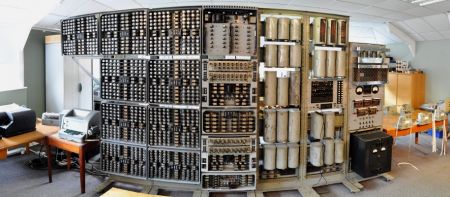
Some of the industrial equipment I work with was made in the 1950s and 1960s. When you pull the disconnect to power it on all you hear for a few seconds is the clatter of the relays as the vacuum power supplies reach operating temperature, the relays gradually closing as they reach their voltages and connect the next circuit up the line.
Stand near the relay board while it is moving and you hear the steady clunking of the relays opening and closing.
Today that entire board full of relays except for the final output can be implemented in a single PLC box no larger than a beer can, and all but the main motor relays can be replaced with miniaturized components to reduce that wall of wiring down to a little shoebox of electronics.
But where's the fun in that? I have no idea how many hours I spent once tracing wiring, only to find a genuine bug- a box alder beetle had become wedged in the relay contacts, preventing the relay from making the connection. An event of similar nature was how the computing term bug came to be- an engineer working on a computer did exactly what I did and came across a bug having jammed a relay.
A short distance from that machine is one made in 1973. Although it lacks the vacuum tubes, and the relays are fewer in number, it still has its original Pratt & Whitney solid state servo amplifiers constructed from discrete silicon devices before the days of integrated circuits. Alas the computer on it was replaced in 1997, but even that is now considered old technology that people qualified to repair are rapidly becoming hard to find.
There seems to be quite a bit of that- Industrial equipment that has served 40 years or more that is still in regular use. Unlike normal computing hardware that is designed for complete replacement every 3-5 years, the cost of industrial gear is so much higher that factory owners usually repair it over replacing it with newer hardware. And I can't say I blame them, considering that in 1996 one of the smaller machines at this facility was purchased new for $120,000. Today it would be a quarter million dollar piece of equipment to replace.










 (though nothing is wrong with that, IMHO)
 Good point!


 - carpe noctem


