


IF what is written in her post is true in all respects, then I feel sorry for rachelbythebay. She's apparently been made a victim of.
Perhaps not so surprising, really: Google's "free food" is not free
- but sad to see if Google's true colours have come out ($green$), as is suggested.
"Not so surprising" because - and I feel obliged to state this - allowing an employer to make so-called "free food" an item with an agreed fixed notional $ value in your employment contract would seem to be an incredibly naive (if not stupid) thing to do, but there we are.
No, that's not the lesson. The lesson is a set of rules/guidelines: (off the top of my head)
In the above blog post, rachelbythebay has already been made a victim, and the victimiser is the employer.
But in the case of rachelbythebay, she unwittingly made herself a victim when she entered into that employment contract under those terms. She did that because she had the "wrong" paradigm to start with.
Protesting about it afterwards, or feeling hurt or feeling that you have been short-changed and then arriving at a wrong conclusion ("my lesson learned") is classic after-the-event victim mentality.
After being ripped-off in minor ways a couple of times, I learned years ago from a book entitled "How to be a non-victim" (or something like that), that you needed to maintain a non-victim state of mind before dealing with anyone - so you avoid being made a victim of in the first place.
From my experience, this isn't necessarily an easy thing to do, as it requires you to modify your behaviours and habits and to change your paradigms, and to fight back. But the important thing was that I did do it, and so could anyone else.
Perhaps even more importantly, as well as learning to be a non-victim, I learned to be a non-victimiser.
Perhaps not so surprising, really: Google's "free food" is not free
- but sad to see if Google's true colours have come out ($green$), as is suggested.
"Not so surprising" because - and I feel obliged to state this - allowing an employer to make so-called "free food" an item with an agreed fixed notional $ value in your employment contract would seem to be an incredibly naive (if not stupid) thing to do, but there we are.
Spoiler (click to show/hide)
From: Google's "free food" is not free
In the summer and fall of 2006, I went through a multi-month process to interview there. After a bunch of phone calls, a flight out to Silly Valley for on-sites, and even more phone calls, they finally offered me a job. Then we had to talk about money.
At the time, I had read nothing about negotiation, and didn't know what I was doing. They offered a sum which was in fact an improvement over what I had been making, but it wasn't the kind of offset I was looking for.
What I find interesting now is that they had a ready-made comeback: they'd "go away to calculate" for a bit, and then say that the meals alone were worth some amount of money. I think they told me 15 to 20 thousand dollars at the time. I've heard other values from other people who were told similar things during their hiring process.
The point is, they deliberately inserted the food as a part of the bigger picture in lieu of more money. They set it up so that you would be placated by it somehow.
At that point, I was still buying the hype of the early days, and I now regret to say that it worked on me. I took it hook, line and sinker and accepted their offer. My effective salary was some amount of cash plus the food as it was right then and there.
For a while, this worked. I was able to get a decent meal at regular intervals without having to hunt for it. There was a certain amount of consistency if you knew where to look for it. One cafe in particular was actually an import of a local chain of taquerias called Andale. You could be sure of finding certain foods there every single day, and not surprisingly, they saw me a lot.
Then something changed. It all seems to coincide with a certain new CFO coming on board, but I can't prove that's what happened. All I know is that certain things started being cut. Entire meals were eliminated from certain cafes. Some that were open for breakfast and dinner in addition to lunch were now lunch-only. Others slid their hours back. Still more wound up being underprovisioned so that even though they might have been open, they ran out of food well before closing time.
Similar things happened to the famous micro kitchens. Over time, many of them were either closed, drained of most items, or "temporarily shut down so as to become a media center which will link to another office". Well, they were shut down, but they were never turned into anything else.
The Friday morning bagel or donut supplies also were curtailed. Sure, they still existed, but you now had to go hunt for them. They were no longer set up in a microkitchen near your office. They would now appear only in certain cafes.
At first, the powers that be claimed it was "being green" or "supporting good nutrition", but enough people finally cornered them and got them to admit it was about the cost. All of that other stuff was just a cover story.
My snarky remark at the time was "sure, they're being green... money is green".
It really says something about a company when they use their own employees as their safety net. Sure, go ahead and screw the employees while the economy is bad. They'll stay on and grumble about it, because they can't go anywhere.
But what happens when the economy improves? Those wounds will never heal. Anyone with half a brain will say "hey, these guys are evil!" and will bail for greener pastures. And, not surprisingly, many did. The brain drain has been remarkable. It's not so much that other companies (Facebook and Twitter are the two obvious candidates) are pulling so much as Google has been pushing them out the door.
I learned a powerful lesson here. If you allow them to placate you with some kind of luxury, don't be too surprised when they take it away. They will conveniently forget that it was used as a bargaining tactic.
Or, worse, they'll assign blame to "rogue contractors" and say it was never their policy to do that. Right.
Now where have we heard that before? Rogue contractors?
Quote
I learned a powerful lesson here. If you allow them to placate you with some kind of luxury, don't be too surprised when they take it away. They will conveniently forget that it was used as a bargaining tactic.
No, that's not the lesson. The lesson is a set of rules/guidelines: (off the top of my head)
Quote
- Take the trouble to learn about and understand useful negotiating skills/techniques.
- Take the trouble to learn about and understand contract law - especially employment contract law.
- There is THEM (i.e., the employer) and there is YOU, and they are obliged (as good corporate psychopaths) to regard any contract negotiation as a confrontation where they know what conditions they want to meet in order to WIN. THEY (being psychopaths) lack empathy and don't care about YOU.
- THEY are usually going to be much bigger and stronger than you in any employment negotiation, unless you can catch them in a contractual error. (It's been known to happen - been there, done that.)
- RULE: Never allow yourself to enter into an employment contract where your cash benefit is reduced/substituted by an estimated fixed or variable notional dollar amount for a fixed or variable non-cash item or "perk", as a term of the contract.
- By all means get an estimate of the cash-equivalent of the item, and then say "No thanks, I'll take the cash" - whether a perk like food or a car. Cash is liquidity and readily convertible into something you can eat. You can't eat a car.
- The only exceptions to this would be where there was a significant dollar tax-benefit or cashflow benefit that you could gain by taking the cash-substitute. There are not many of these nowadays though, as the IR have been closing the loopholes on the tax-benefits, and usually only financial companies are in a position to be able to offer you perks that could give you a cashflow benefit (e.g., a loan or mortgage at a rate well below prevailing market rates).
In the above blog post, rachelbythebay has already been made a victim, and the victimiser is the employer.
But in the case of rachelbythebay, she unwittingly made herself a victim when she entered into that employment contract under those terms. She did that because she had the "wrong" paradigm to start with.
Protesting about it afterwards, or feeling hurt or feeling that you have been short-changed and then arriving at a wrong conclusion ("my lesson learned") is classic after-the-event victim mentality.
After being ripped-off in minor ways a couple of times, I learned years ago from a book entitled "How to be a non-victim" (or something like that), that you needed to maintain a non-victim state of mind before dealing with anyone - so you avoid being made a victim of in the first place.
From my experience, this isn't necessarily an easy thing to do, as it requires you to modify your behaviours and habits and to change your paradigms, and to fight back. But the important thing was that I did do it, and so could anyone else.
Perhaps even more importantly, as well as learning to be a non-victim, I learned to be a non-victimiser.





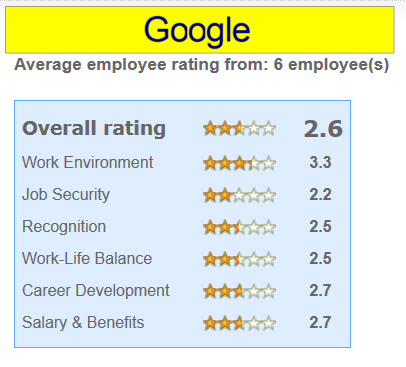
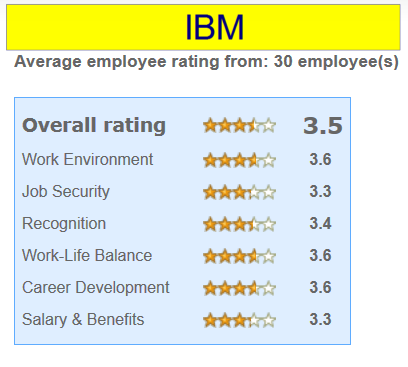
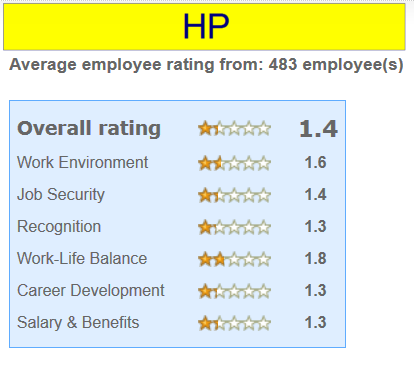


 My point is not that Google is great, just that those numbers don't mean a lot. Oh and Proletar doesn't appear to have Facebook. Er..?