Tech shopping tips
« on: May 20, 2011, 10:28 PM »

 Topic: Tech shopping tips (Read 20,761 times)


1) Do not buy anything remotely close to serial number 0001 of anything.

Experience has taught me - sure, you might have to replace something that breaks several times that one long lasting one will be cheaper in the long run. However, technology moves so fast that if it is ease to fix you can a) fix it quickly, b) often can fix it cheaply, and c) fix it with a superior product featureset. How many of you still have and use your old zip drives? They sure do last, but no one reall uses them anymore, and can you even find drivers for them in Vista/Win7?
For 4a, I believe "fix" really means "replace" in most circumstances. Got an iPod? Battery die? Oh... Just replace the iPod...
Regarding 4b, does "last" mean more than 6 months, or as long as the warranty + 1 day?


1) Do not buy anything remotely close to serial number 0001 of anything.
Unless the make and model is "Fender Stratocaster" *drool*
(says the guy whose great-uncle received #0003 from his good friend Leo who said, "try it out, tell me what you think"; sold in 1970 for $1000)
Or was until they came out with 4-layer boards with plated-thru mounting holes.Like I said, "... it was broke when it left the factory."

Consequently, many municipalities are enacting laws that prohibit just dumping electronics in the trash. And many are now charging a fee to pass such waste on to places that can recycle, detoxify, and dispose of electronics safely. (Which has the unintended consequence of encouraging illegal dumping - but that's a topic for another day.)Really? I have only seen charging from corporations that really don't WANT to deal with it but are forced to. I know our municipality holds regular collections free of charge (and no, that doesn't mean it is paid for by taxes - more on that in a minute). There is quite a bit of valuable material that goes into each machine, and if you can dismantle it, you can make a pretty penny selling it back to the suppliers. The key is dismantling enough of them, fast enough, and completely enough to make it profitable.
Really? I have only seen charging from corporations that really don't WANT to deal with it but are forced to. I know our municipality holds regular collections free of charge
 provided it's residents:
I like the 4a/4b criteria from 40hz. As much as things cost today, it's worth the extra -- and I mean extra -- time spent researching something before you lay down a load of cash for it.


 buying on screen size not resolution. Resolution matters (imo) at least as much as screen size. buying cameras on MP. Once we passed 5MP it becomes far more important to have a good lens, good zoom, good sensors to produce good images. Yet we see cameras making worse images (as in the new model makes worse images than the previous model) but with more pixels, because people buy the MP. ignoring antenna power and battery life on mobile phones.


- espresso machine (hugely over-engineered for domestic needs. Will outlive me. A daily joy to use)
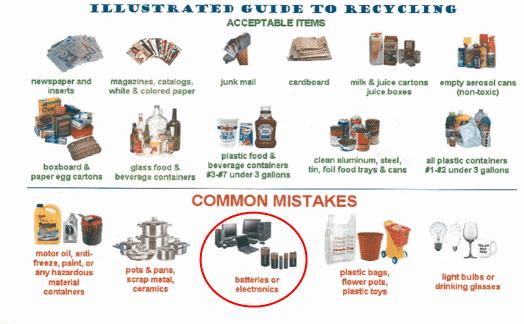
Yeah, we have something similar from our waste management group. That is why they brought in the electronics recycler through. I am still stuck on the batteries and light bulbs, however. We have plastics picked up weekly, along with most metals (though I keep them and recycle them at the local scrap yard myself) and we have multiple HAZMAT dropoffs throughout the year for paint, oil, etc.; but the batteries and bulbs are a real bind if you are to follow their strict guidance.Really? I have only seen charging from corporations that really don't WANT to deal with it but are forced to. I know our municipality holds regular collections free of charge
Yup! Here's the handy-dandy infographic my town has so helpfully
<image removed>
They do have two "hazardous waste" days per year where you can bring the usual stuff (pesticides, lawn & pool chemicals, small propane tanks, non-latex paints and thinners, etc.) in for free disposal. But they won't accept electronic components or devices. The only exception to their "no electrical items" rule is dead car batteries.
Original address: https://www.donationcoder.com/forum/index.php?topic=26814.0