


Source: http://moritz.stefaner.eu/projects/elastic-lists/
NY Times Article search demo: (Warning requires Javascript)
http://moritz.stefaner.eu/projects/elastic-lists/NYT/
Forgot where I got the link:
http://thenoisychannel.com/2010/05/20/elastic-lists-for-faceted-search-now-open-source/
Quote
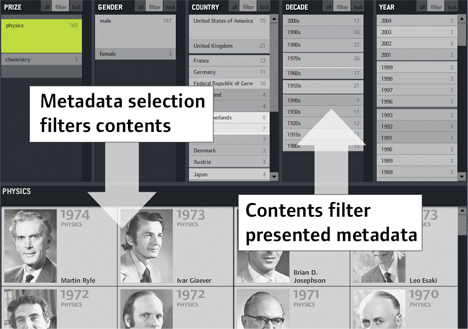
Elastic lists allow to navigate large, multi-dimensional info spaces with just a few clicks, never letting you run into situations with zero results. They enhance traditional UI approaches for facet browsers by visualizing weight proportions, animated transitions, emphasis of characteristic values and sparkline visualizations
NY Times Article search demo: (Warning requires Javascript)
http://moritz.stefaner.eu/projects/elastic-lists/NYT/
Forgot where I got the link:
http://thenoisychannel.com/2010/05/20/elastic-lists-for-faceted-search-now-open-source/
Quote
To me, it shows everything that can go wrong with faceted search. Try a search for [google] in that demo. If you have the reaction I did, you’ll hit immediate paradox of choice from all the options presented, many of which seem almost random.
Don’t get me wrong, I’m a huge fan of faceted search when implemented well. I’m just not sure this is the best example of a well done implementation?
That demo has issues, but I don’t think those damn elastic lists per se. Some of my criticisms: too many facet values as refinement options, lack of parallelism (e.g., locations aren’t hierarchical and some options should be children of others), lack of normalization of organizations (e.g., google and google inc.), and a confusing description facet (e.g., choices include “computer software” and “software”). In contrast, the Nobel Prize demo strikes me as a much better demo of elastic lists.


