Re: What books are you reading?
« Reply #975 on: September 28, 2018, 03:17 AM »


 Topic: What books are you reading? (Read 1,140,538 times)



...I am reading an interesting book at the moment, as I explained in a separate post......I had not actually wanted to read it, though I had been steeling myself for the time when I would have to.
I am reading this English translation, here, if you want to take a look: Adolf Hitler - Mein Kampf (James Murphy translation).pdf...
From Mein Kampf, by Adolf Hitler - from pages 78 and 79:
... By far the most effective branch of political education, which in this connection is best expressed by the word 'propaganda', is carried on by the Press. The Press is the chief means employed in the process of political 'enlightenment'. It represents a kind of school for adults. This educational activity, however, is not in the hands of the State but in the clutches of powers which are partly of a very inferior character. While still a young man in Vienna I had excellent opportunities for coming to know the men who owned this machine for mass instruction, as well as those who supplied it with the ideas it distributed. At first I was quite surprised when I realized how little time was necessary for this dangerous Great Power within the State to produce a certain belief among the public; and in doing so the genuine will and convictions of the public were often completely misconstrued. It took the Press only a few days to transform some ridiculously trivial matter into an issue of national importance, while vital problems were completely ignored or filched and hidden away from public attention.
The Press succeeded in the magical art of producing names from nowhere within the course of a few weeks. They made it appear that the great hopes of the masses were bound up with those names. And so they made those names more popular than any man of real ability could ever hope to be in a long lifetime. All this was done, despite the fact that such names were utterly unknown and indeed had never been heard of even up to a month before the Press publicly emblazoned them. At the same time old and tried figures in the political and other spheres of life quickly faded from the public memory and were forgotten as if they were dead, though still healthy and in the enjoyment of their full viguour. Or sometimes such men were so vilely abused that it looked as if their names would soon stand as permanent symbols of the worst kind of baseness. In order to estimate properly the really pernicious influence which the Press can exercise one had to study this infamous Jewish method whereby honourable and decent people were besmirched with mud and filth, in the form of low abuse and slander, from hundreds and hundreds of quarters simultaneously, as if commanded by some magic formula.
These highway robbers would grab at anything which might serve their evil ends.
They would poke their noses into the most intimate family affairs and would not rest until they had sniffed out some petty item which could be used to destroy the reputation of their victim. But if the result of all this sniffing should be that nothing derogatory was discovered in the private or public life of the victim, they continued to hurl abuse at him, in the belief that some of their animadversions would stick even though refuted a thousand times. In most cases it finally turned out impossible for the victim to continue his defence, because the accuser worked together with so many accomplices that his slanders were re-echoed interminably. But these slanderers would never own that they were acting from motives which influence the common run of humanity or are understood by them. Oh, no. The scoundrel who defamed his contemporaries in this villainous way would crown himself with a halo of heroic probity fashioned of unctuous phraseology and twaddle about his 'duties as a journalist' and other mouldy nonsense of that kind. When these cuttle-fishes gathered together in large shoals at meetings and congresses they would give out a lot of slimy talk about a special kind of honour which they called the professional honour of the journalist. Then the assembled species would bow their respects to one another.
These are the kind of beings that fabricate more than two-thirds of what is called public opinion, from the foam of which the parliamentary Aphrodite eventually arises.
Several volumes would be needed if one were to give an adequate account of the whole procedure and fully describe all its hollow fallacies. But if we pass over the details and look at the product itself while it is in operation I think this alone will be sufficient to open the eyes of even the most innocent and credulous person, so that he may recognize the absurdity of this institution by looking at it objectively. ...


Dumped:


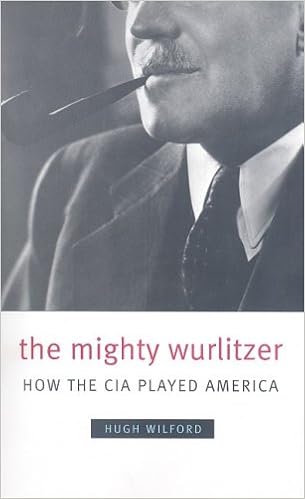
The Mighty Wurlitzer: How the CIA Played America by HUGH Wilford. This is certainly one of the best books I've read, period. Wilford takes on an insanely ambitious and important subject that's been obscured by secrecy and history. He does it great justice and the writing itself is amazingly good. Once the premise and reality is established, Wilford kicks things into high gear, providing hundreds of pages of eye-opening connections that will change the way you think about the past six decades of US popular culture. It is a source of great amusement to me that so few self-proclaimed "conspiracy theorists" have even heard of this book, because their paranoia pales by comparison to what Wilford is laying out in abundantly documented detail here.




Dumped:
This book is available from Amazon for (Kindle $12.99), (paper $9.91) here. Panzer, what was your opinion of it?




















Catherine Fisher writes: I have always thought the idea of Time Travel fascinating, full of paradox and speculation and opportunities for adventure.
If you had the power to change previous events to bring back someone that you loved, would you do it, even if it changed the world? In Venn I wanted to invent a man so deep in guilt that he has lost the ability to care about anyone else.
Into this dilemma I wanted to mix all the old folklore: the wintry isolated house, the dark wood, the beautiful, deadly Shee and their ageless, changeless land; the eccentric inventor, the opium dens and alleys of Victorian London.
I wanted a story full of variety and mystery. And above all, enjoyment.






Why are we all so damn stupid?- i.e., we can't help it. The reason seems to be that our paradigms and perceptions of reality and especially our thinking are filtered through a primitive ego-centric mechanism that is hard to disassociate our thinking from, in a sort of intellectual deadlock, and the smarter the individual (IQ), the more secure the deadlock and the harder it becomes to be objective (De Bono in the book Teaching Thinking). The Vedic philosophers of 3,000 years ago knew about this and called it ahamkara - a state of illusion in the mind, which is perceived to be reality and is connected to the concept of the Self and the survival of the ego. The concept of ahamkara can be found in Hinduism today - as part of the lower (physical) mind below the Buddhi intellect.
Genuine philosophical thought, depending upon original individual insights, arose in many cultures roughly contemporaneously. Karl Jaspers termed the intense period of philosophical development beginning around the 7th century and concluding around the 3rd century BCE an Axial Age in human thought. - per Ancient Philosophy.I used to feel pretty pessimistic about humanity's forward evolutionary progress, as otherwise "democratic" nations leading the way often seemed to be (especially in the US or Europe, for example) in a near-perpetual state of unrest driven by internecine divisive and antithetical religio-political ideologies intent on destruction/suppression of "the other" - leading to implicit brown-shirting, political correctness, de-platforming and oxygen starvation against "incorrect" thinking and the loss of freedom of thought and speech and ultimately self-destruction of the democracy. In the US for example - the torchbearer for freedom and democracy - think Univ. of Berkely (that bastion of free speech) and where organised riots and apparently complicit administrators shut down freedom of speech, and a US presidential candidate who divisively publicly labelled the voters (potentially half the plebiscite) of their opponent as "a basket of deplorables", or some such, and people apparently still cannot safely walk in a public place in the US wearing the "wrong" sort of hat. In Europe, the Mother of Democracy - the British Parliament - has passed laws limiting freedom of speech - i.e., loosely-defined "wrong" or "incorrect" speech - and on the world stage, the manipulative Google and Facebook seem to be opportunistically encouraging yet more government intervention and regulation of freedoms for self-serving purposes as they attempt to externalise the cost of and their responsibility for mitigating harms to cultures and societies arising directly and indirectly from the delivery of their services (situation normal for a corporate psychopath, which always seeks to externalise the costs of its environmental footprint). Singly and together, these things represent a seemingly remorseless onslaught on privacy and freedom. I could go on, but you get the idea.
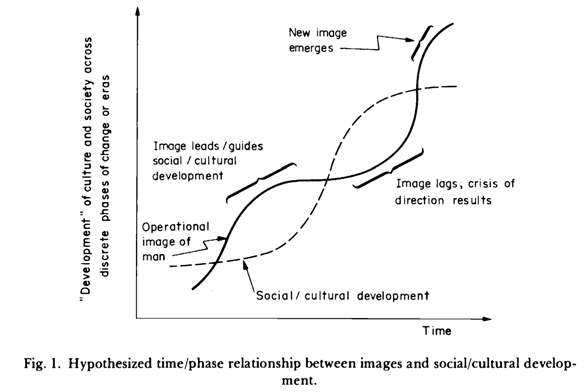
...An image may be appropriate for one phase in the development of a society, but once that stage is accomplished, the use of the image as a continuing guide to action will likely create more problems than it solves. (Figure 1 illustrates, in a highly simplified way that will be further developed in Chapter 3, the interaction between "changing images of man" and a changing society.) While earlier societies' most difficult problems arose from natural disasters such as pestilence, famine, and floods (due to an inability to manipulate the human's environment and ourselves in unprecedented ways, and from our failure to ensure wise exercising of these "Faustian" powers-as Spengler termed the term).The SRI report provides a hypothetical semi-sinusoidal model in a diagram and which intriguingly effectively suggests that cultural and social outcomes could be a de facto weighted average of individual desires (in the minds of people). If so, a freedom-negative outcome that most people dislike - e.g., having been pulled into that state by (say) a dictatorship - can't persist over time and will be pushed into an upwards development, through some form of dynamic change (e.g., activism, revolution).
Science, technology, and economics have made possible really significant strides toward achieving such basic human goals as physical safety and security, material comfort, and better health. ...
pp 4 - 6, Changing Images of Man - SRI report
...I thought it was an old hat hypothesis - I mean, I was taught - and thought I understood - that the only real current human evolution that was taking place was in cultural developments...I usually try to substantiate what I write with examples, but I couldn't find my old lecture notes as I lost them in a fire. However, after scratching my head a bit and using duckduckgo, I eventually managed to come up with this:
The very concept of progress — of the continual betterment of the human condition through the application of science and the spread of freedom — was a product of the European Enlightenment, as Kishore Mahbubani reminds us. These thinkers were among the first to advance the idea that humanity’s problems are soluble, and that we are not condemned to misery and misfortune. The spectacular progress that ensued, first for the West and then increasingly also for the rest, was a matter not of historical necessity, but of diligent human effort and struggle. Pessimism is not just factually wrong, it is also harmful because it undermines our confidence in our ability to bring about further progress. The best argument that progress is possible is that it has been achieved in the past.
– Maarten Boudry
Original address: https://www.donationcoder.com/forum/index.php?topic=20287.0