What do you get when you cross something like Launchy and Mouser's FARR and wrap it in something that looks like an Adobe Air interface? You get Ubuntu's HUD (Heads Up Display) - Mark Shuttleworth's latest foray into 'original'

interface design for his adopted wonder-child.
Check out the following video. Does any of this look familiar?
It's a bit much to go into in a post. So the logical starting place is
Mssr. Shuttleworth's own blog where he speaks rapturously about his latest brainstorm:
Introducing the HUD. Say hello to the future of the menu.
Tuesday, January 24th, 2012
The desktop remains central to our everyday work and play, despite all the excitement around tablets, TV’s and phones. So it’s exciting for us to innovate in the desktop too, especially when we find ways to enhance the experience of both heavy “power” users and casual users at the same time. The desktop will be with us for a long time, and for those of us who spend hours every day using a wide diversity of applications, here is some very good news: 12.04 LTS will include the first step in a major new approach to application interfaces.
This work grows out of observations of new and established / sophisticated users making extensive use of the broader set of capabilities in their applications. We noticed that both groups of users spent a lot of time, relatively speaking, navigating the menus of their applications, either to learn about the capabilities of the app, or to take a specific action. We were also conscious of the broader theme in Unity design of leading from user intent. And that set us on a course which lead to today’s first public milestone on what we expect will be a long, fruitful and exciting journey.
The menu has been a central part of the GUI since Xerox PARC invented ‘em in the 70′s. It’s the M in WIMP and has been there, essentially unchanged, for 30 years.
What I find quite interesting in this blog post is the first image that follows the above text. It's this:

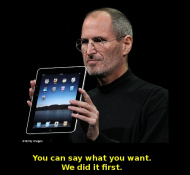
Yes. It's an original Apple desktop. Do you begin to suspect where Mr. Shuttleworth is going with this now that the 'Son of Zeus,' Steven Jobs has quit this mortal clay? Apparently there's a perceived vacuum in the computing universe. And Mark Shuttleworth abhors that vacuum.
Unfortunately, I think Mr. Shuttleworth fails to appreciate that the current desktop metaphor (WIMP) has been in place for 30 years because it
works. It's a proven design that admittedly has its faults and shortcomings. But it works. And people get a lot of things done using it.
And despite the flowery prose, as it stands from its given description, there is
nothing new in HUD. It's a mashup of adaptive interface ideas and launchers that have been around for years. And there are numerous realizations of them available for download on all the major software sites.
Hmm...Maybe, if Mr. Shuttleworth knew a little more about software and interface design, he'd know that?
What is it about non-coders and non-engineers that they feel the need to try to carve out a place for themselves in computing history without mastering any of the skill set required to earn such a name? When did "design" and "vision" replace engineering, programming skills, and computer science as requisites for true innovation?
Oh...that's right! It happened when Steve Jobs decided to ride into town on the coattails of people like Steve Wozniac, Jef Raskin, Andy Herzfeld, Burrell Smith, and a host of others. Failing to master any technical skill, Jobs called himself a "designer," and then unilaterally put himself in charge of the people who
did have real skills.
And now it looks like Mark Shuttleworth is heading down the same road. And dragging Ubuntu along with him.
There's a couple of articles over at ZD's website that might be worth reading. The first is a quick intro to HUD. The second, is another one of ZD's usual cautious don't-rock-the-boat follow-ups.
Beyond the desktop: Ubuntu Linux's new Head-Up Display
By Steven J. Vaughan-Nichols | January 24, 2012, 8:13am PST
Summary: Following on the heels of changing its interface from the GNOME 3.x shell to Unity, Ubuntu is proposing a new, radical change to the desktop Linux interface: Head-Up Display.
Mark Shuttleworth, founder of Canonical Ubuntu Linux’s parent company, has announced that Ubuntu will be adopting a radical new change to the interface that will do away with the “menu” in the Windows, Icons, Menus, Pointer (WIMP) interface, which has defined the desktop for the last thirty years.
Shuttleworth states, “The menu has been a central part of the GUI since Xerox PARC invented ‘em in the 70?s. It’s the M in WIMP and has been there, essentially unchanged, for 30 years. We can do much better!” This new interface, which will first appear as a beta in April’s Ubuntu 12.04 release, is called Head-Up Display.
Link to above article
here.
Linux users cautiously optimistic about Ubuntu's Head-Up Display desktop
By Steven J. Vaughan-Nichols | January 26, 2012, 8:55am PST
Summary: Most users seem willing to give Ubuntu Linux’s Head-Up Display interface the benefit of the doubt.
When Ubuntu announced that it was going to switch to Unity for its primary Linux desktop, some users were outraged by Ubuntu’s shift to a new interface. Many turned to Linux Mint in place of Ubuntu. So, when Ubuntu founder Mark Shuttleworth announced that Ubuntu would be moving from Unity to Head-Up Display (HUD), I expected Linux users to be even more annoyed. I was wrong. Instead, they are taking a wait-and-see attitude to HUD.
Link to above article
here.
The thing that really makes something like this a problem for me is Canonical's plan to offer HUD as a
replacement - not an add-on or an accessory - to the standard menu and mouse interface. As was the case with Unity, Canonical is deliberately walking away from the larger Linux community with interface decisions that will end up
becoming the equivalent of a proprietary interface since it's doubtful any other distros will follow them down the path they're taking.
And all because somebody decided to do
something different
purely for the sake of doing
anything different - just so long as he can put his own name on it.
 Ubuntu's Latest Interface "Brainstorm" - HUD


